
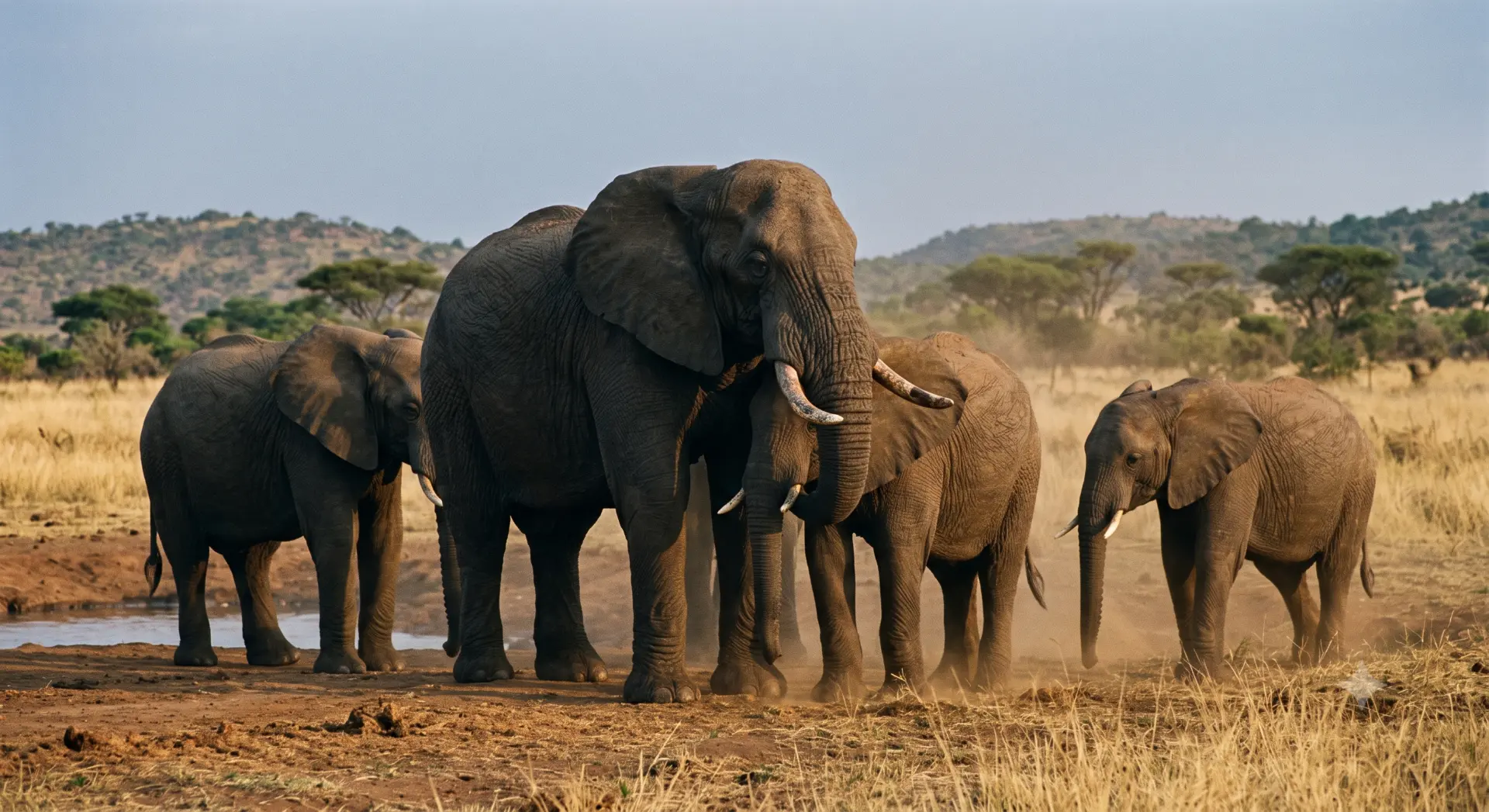
The park
In the early 1990s, rangers at Pilanesberg National Park in South Africa began finding dead white rhinos. The wounds were unusual. Rhinos have few natural enemies, and poachers take the horn, which these carcasses still had. Over a few years the count reached dozens, and for a long time nobody could say who was doing the killing.
The answer turned out to be the elephants. Pilanesberg had been stocked in the previous decade with young orphans from culling operations in Kruger. Adult elephants were too large to move, so the park received a generation of calves with no adults among them. By the 1990s those calves were young bulls entering musth, the periodic surge of testosterone and aggression that adult males cycle through. They were entering it years earlier than they should have, and staying in it far longer than normal. With no older bulls in the park, nothing suppressed it. Hyper-aggressive adolescents, unable to find the fights musth is built for, turned on the rhinos.
The fix was small. Six mature bulls were brought in from Kruger. The young males dropped out of musth, and the rhino killings stopped. Nobody had to redesign the young elephants. Their strength and drive were intact. What they had lacked was the presence of animals whose rank told them when that drive was allowed to run.
Rob Slotow and his colleagues published the account in Nature in 2000, and it has circulated ever since in leadership circles as a parable about mentoring. I think that reading undersells it. The story is about what happens when capability arrives before the layer that regulates it, and that is the condition of a great many companies adopting AI today.
The ladder
Picture the young bull as an AI model or an agent. It is capable and fast, and it has no built-in sense of when to hold back. Now picture the company that deploys it as a young bull too. It has suddenly acquired more capability than it grew up with, and no senior animal in the organization has the job of setting the tempo. Both readings hold, and the second is the uncomfortable one, because it says the adolescent in the story is the executive team.
In my own work I use a five-level readiness scale, numbered 0 through 4. Level 0 is a company with no meaningful AI use. Level 1 is individual use, ungoverned. Level 2 is the first governed workflow. Level 3 is a stable operating model in which humans and agents have defined roles and the norms hold without an outside intervention. Level 4 is a company that evaluates, revises, and spreads improvements across its workflows on purpose, faster than any single team could manage by hand. The elephant story begins at Level 1 and reaches Level 3. It does not reach Level 4.
Level 1 is the orphan cohort. Individuals across the company are using AI tools on their own, with no visibility into what they produce and no measure of quality or cost. Every employee has a young bull. Harm, when it comes, tends to land on customers and partners before it lands on the company, and it surfaces as anomalies nobody is tracking. Many organizations sit here today, and where they do, the rhinos are already dying somewhere in the ecosystem, unattributed.
Level 2 is the moment the older bulls arrive. In a company this is the first governed workflow, the gateway every model call passes through, the first evaluations, the first evidence a board can be shown. The agents are the same agents. What is new is the regulating layer, and the elephants say less about what that layer should be made of than the parable suggests. What they show is that it has to be present, and that the regulated party has to respond to it. In a company that means a layer with relevant visibility and effective authority, which can be assembled from permissions, deterministic controls, evaluations, supervising models, and accountable people. A log nobody reads and a model with no power to intervene are both decoration.
Level 3 is the rung where the park settles. A stable hierarchy has formed, and musth arrives at the right age and lasts the right length of time. The young bulls learn restraint from the animals around them rather than from a translocation, and elephants learn a great deal that way, including where to find water and which routes are dangerous. The story depends on that learning. For a company, Level 3 is the point where the norms live in the operating model rather than in the consultant who installed them. A governed workflow stays governed after the people who built the gateway have left.
Level 4 is where the analogy stops carrying weight. Restoring a functioning social order is a real achievement, and Pilanesberg did it. It is a different thing from measuring how work is going, changing the method, and pushing the change to every workflow that could use it. Doing so on purpose, with a way to tell whether the change helped, is a further thing again. The elephants have no version of that loop. The story ends at Level 3, and everything above it has to be built.
Three rules fall out of the mapping.
Oversight should vary with the work. A pilot is treated differently over the ocean than on final approach, a point I will come back to, and an agent summarizing internal documents is a different animal from one issuing refunds. The weak section of the park still matters. An ungoverned workflow with real permissions and real consequence can undo the credibility of every governed one beside it, and the place to look first is wherever an agent can do the most damage unchecked.
Dose matters. The park introduced six bulls, and six was a choice. Oversight is a provisioned resource, and a company that scales agents faster than it scales the layer watching them has thinned the elders without ever making that decision.
And feedback from inside the herd will never show you the rhinos. The elephants were fine by every measure the elephants had. If the only signal a company collects comes from inside its own walls, the harm it causes downstream stays invisible until someone outside counts the carcasses.
The tower
The elephants show what regulation looks like when it evolves. For what it looks like when you have to build it, look up.
A pilot crossing the North Atlantic files a route and is, for most of the crossing, left largely alone. The same pilot on final approach into a busy airport is under close, continuous direction. Nothing about the pilot changed between the ocean and the runway. What changed was the density of consequence in the surrounding air, and the control matched it. The readiness ladder is the same idea applied to work.
Air traffic control has three other lessons the elephants cannot give.
Controllers do not outrank pilots because they are wiser. They have radar, which lets them see traffic the cockpit cannot, and they have the authority to issue an instruction a pilot must follow or formally refuse. Visibility and authority together make the layer work. A company's governance layer earns its place the same way, by seeing across every workflow what no single agent can see from inside one, and by being able to act on what it sees.
Controllers are staffed to the traffic. When demand exceeds what the people on duty can safely hold, the system meters the demand, holding aircraft on the ground or in the air until capacity returns. The dose rule from Pilanesberg has been written into procedure, and it implies a conclusion most companies resist. If the control layer cannot keep up, the honest response is to slow the deployment.
And the system was rebuilt after the crashes. Air traffic control existed before the 1950s. A series of mid-air collisions, including one over the Grand Canyon in 1956, exposed how far it had fallen behind the traffic, and the reforms that followed gave it much of its present shape. The rhinos came first there too. Since then the system has been revised more or less continuously, and nobody treats it as installed.
Where the story ends
The elephants recovered because the answer already existed. Six older bulls carried a million years of regulation in their bodies, and all the park had to do was find them and open the gate.
There is no such animal for what companies are building now. Nobody has evolved the elder for an organization run partly by software. The layer has to be designed, then paid for, then owned by the people who will still be there when the designers leave. Building and owning that layer is the Level 2 and Level 3 work, and aviation shows it can be done at scale, at cost, and after loss.
Level 4 asks for something more. Aviation learns from its failures, but it learns slowly, through investigation and rulemaking, and a change to procedure takes years to reach every cockpit. A company at Level 4 changes a workflow in a week, and the change spreads to every workflow that resembles it, much of the spreading done by software. The speed is the point, and the speed is the danger. A company that learns across its workflows without a fresh intervention each time can also learn the wrong thing the same way.
Suppose an agent handling refunds is tuned to resolve cases faster, and it does. Processing time falls, the metric everyone watches improves, and the tuning is copied to returns, credits, and disputes. What nobody measured is that the faster path denies more claims that should have been paid. The customers absorbing those denials are the rhinos of this story, harmed by an improvement that every internal signal called a success. The faster the improvement spreads, the more the system needs a way to detect that an improvement is a mistake, and someone accountable for pulling it back. The fifth rung carries a heavier burden of verification than the four below it, and any framework that promises compounding without saying how the compounding is checked has left out the hard part.
No elders are coming. The park could send for its bulls, and the airlines could write their rules after the crashes. A company adopting AI has to build the elder, own it after the builders leave, and check what it is teaching. That work is the operating model, and you do not have to wait for the collision to start it.
#AIGovernance · #AIAdoption · #OperatingModel · #ResponsibleAI · Deep Tech