Sovereign Pivot

Speaking Catalog.

Dr. Larry Chao

AI · Deeptech · Startups · Future of Work · SF / Tokyo / Taipei

Filter by theme11 talks
  1. 01

    The Sovereign Pivot: Agency in the AI-Shaped Future of Work.

    AIFuture of WorkCareer

    Dr. Larry Chao shares a plain-spoken tour of how innovation and work is changing, with lessons from his own career to the trends we’re seeing across industry. The talk will start with a snapshot of today’s job market and look at the evolution of work as it migrated from artisans to corporations to today’s independent creators, gig economy, and startups. Finally, we’ll look ahead to the increasingly AI-shaped future of work and how GenAI tools and AI agents can help anyone upskill, stand out, or even run a “company of one,” covering practical tips and a picture of where your career can go in this new world.

  2. 02

    The AI-Native Startup Playbook.

    AIAI-NativeStartupsResponsible AI

    The AI-Native Startup Playbook introduces a new operating paradigm for founders building in the age of human-AI orchestration. Drawing on case studies and accelerator experience, the session contrasts AI-enhanced and AI-native models where trust, data, and agentic automation define competitive advantage. It explores two key innovation vectors: Vertical AI (deep domain solutions) and Agentic AI (horizontal, multi-function orchestration) and the infrastructure stack, ROI frameworks, and governance principles that make them scalable. The talk highlights responsible AI as both a compliance necessity and a growth enabler, showing how fairness, transparency, accountability, and privacy can become differentiators. Founders will learn how to design human-AI teams, price for the AI era, and use distribution and trust as moats. Ultimately, this playbook reframes leadership for the AI-native era: balancing speed with stewardship, embedding responsibility into innovation, and turning governance into strategic leverage.

  3. 03

    Building Your AI-Native Career.

    AIAI-NativeCareer

    In a world where excellence kills and capabilities save, the divide between success and obsolescence is no longer about hard work—it is about agency and orchestration. This session provides a strategic roadmap for those early in the career to upskill and stand out, moving from an AI luddite to a high-output architect. Whether your goal is to thrive within a global enterprise, join a startup, or launch a “company of one,” you will learn to transition from using AI as a microtasker for simple emails to a copilot for collaborative coding or to a delegate that handles complex goals independently. This talk helps you show the agency and invest in your skills to build your career with confidence.

  4. 04

    What to Do When Nobody Knows What’s Coming: Navigating an Unpredictable, AI-Shaped Future of Work.

    AIFuture of WorkCareer

    The ground beneath careers is already shifting — jobs are being unbundled, career arcs are shortening, and the people building AI are the ones warning us about what’s next. But predictions about the future of work have a lousy track record in both directions: the doomers and the cheerleaders are both reliably wrong. So how do you make real decisions inside genuine uncertainty? This talk cuts through the noise with a practical framework — six moves for building a career (and a life) that holds up across multiple possible futures, from investing in complements to AI rather than competing with it, to building the things AI can’t fake, to diversifying what defines you beyond your job title. For students, early-career professionals, and anyone advising them who wants honest guidance instead of false reassurance.

  5. 05

    The AI-Native Job Search.

    AIAI-NativeCareer

    The traditional “post and pray” approach to job seeking has become obsolete in a hyper-competitive, AI-driven market. This presentation proposes a strategic shift toward an AI-native search, where candidates operate with the precision of a modern Go-to-Market campaign. By leveraging AI to synthesize a North Star professional identity and transform static resumes into optimized, industry-aligned assets, applicants can bypass automated hurdles. The framework emphasizes predictive targeting and signal-based opportunism to identify high-value roles before they are widely publicized. Ultimately, this session demonstrates how to move from passive searching to active career execution, treating the job search as a sophisticated acquisition process defined by data-driven excellence and personalized strategy.

  6. 06

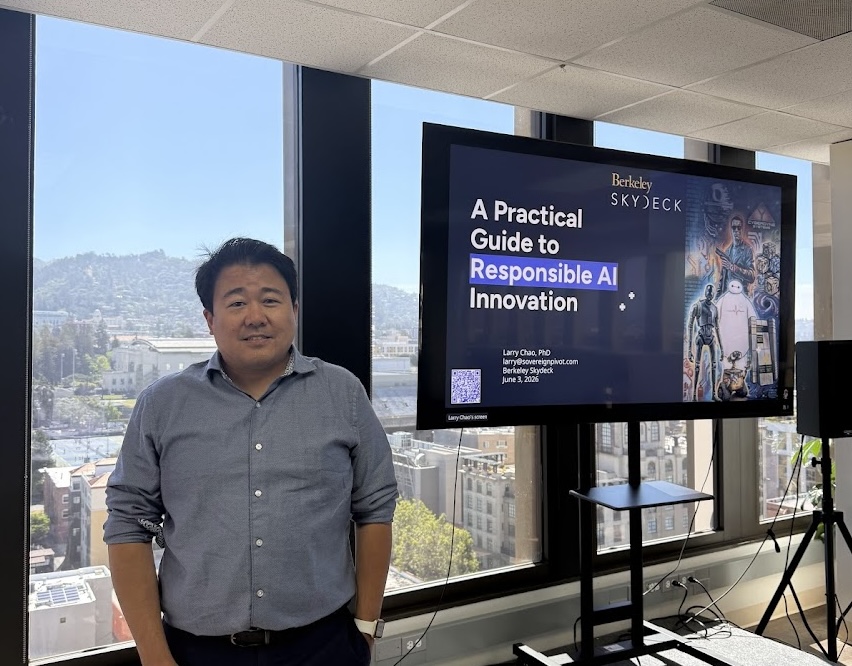
    A Practical Guide to Responsible AI.

    AIResponsible AIStartups

    In this session, we explore how companies and innovators can build and scale artificial intelligence responsibly—ensuring that rapid innovation aligns with human values and societal good. Drawing from global trends like accelerated AI advancement, emerging governance models, and rising ethical concerns, the talk introduces key distinctions between Ethical AI, Responsible AI, AI Safety, and Human-Centric AI. The heart of the discussion centers on four core principles of Responsible AI: fairness & bias mitigation, transparency, accountability, and privacy & security. The talk will also dive into practical steps startups can take to implement responsible AI including where to start, how to integrate it into your design process, and building the interdisciplinary teams and frameworks for continuous improvement and engagement. The session closes with a look at resources and how companies can treat Responsible AI not as an afterthought—but as a competitive advantage and moral imperative.

  7. 07

    The Deeptech Startup Lifecycle.

    DeeptechStartupsAI

    This talk provides a concise summary of the unique challenges and stages faced by companies built on deep technology—scientific discovery and meaningful engineering breakthroughs like AI, quantum computing, and biotech—as opposed to typical software or SaaS ventures. Deeptech is characterized by long time-to-market (7–15+ years), high capital intensity ($50M–$200M+), and a competitive moat built on defensible IP. The lifecycle begins with a Founding Insight from a lab or university, moves through multi-year stages of R&D and Proof of Concept (technical validation), followed by Go-to-Market Proof (pilots and clinical trials), and culminates in Scaling Commercialization, which requires navigating complex regulatory environments and securing large-scale funding for infrastructure. The talk emphasizes that exits are often later and frequently involve acquisition by industry giants, advising founders to plan for long horizons, anticipate regulation, and leverage strategic partnerships.

  8. 08

    Building Bridges Beyond the PhD: Empowering Your Next Chapter.

    ResearchDeeptechCareer

    The commitment of PhD students affirms their role as essential “bridge builders.” The talk outlines how the PhD mindset—rigor, patience, and deep thinking—can guide their future through three essential bridges: From Foundation to Frontier, the PhD is a “masterclass in uncertainty” and a system for failing forward. The skill learned is resilience over perfection. From Isolation to Connection, research must be translated and ideas amplified beyond journals. PhDs must be bridge builders between theory and practice to earn public trust. From Experiment to Impact, the goal is turning knowledge into innovation (e.g., deep-tech startups) and building things that endure. This requires focusing on responsibility and ethics, especially when building human-centric AI. The talk concludes that these bridges form a worldview valuing curiosity, collaboration, and integrity, encouraging students to keep building with courage.

  9. 09

    The Impact of AI on Campus Talent Ecosystem and the Future of Work.

    AIFuture of WorkCareer

    This talk explores the transformative impact of artificial intelligence on the transition from campus to career, detailing how the traditional “job ladder” is being reshaped. Dr. Larry Chao provides a comprehensive Job Market Overview, highlighting the “job-pocalypse” where entry-level roles are vanishing at an alarming rate as companies freeze hiring to assess AI’s capabilities. From an HR and Recruiting perspective, the presentation examines the “hiring arms race,” where AI tools automate everything from resume screening to live technical interviewing, yet sometimes prioritize speed over quality. For the Student Perspective, the discussion addresses the “unraveling of credentialism,” warning against AI-dependency that can lead to a lack of foundational reasoning, while encouraging students to embrace “solopreneurship” and the gig economy. Finally, the talk outlines a roadmap for Building AI Fluency, distinguishing it from mere literacy by emphasizing the strategic application of AI as a “microtasker,” “copilot,” and “teammate” to drive organizational effectiveness.

  10. 10

    Navigating Customer Value and Project Priority in Design.

    DesignStartups

    This presentation addresses the critical reality that most engineering failures stem from ecosystem or priority misalignment rather than technical incompetence. By integrating Customer Value Chain Analysis (CVCA) and the Project Priority Matrix (PPM), teams can transition from narrow technical focus to “Designing with Discipline.” These tools are essential because they force teams to define their “North Star” by mapping complex stakeholder value flows while simultaneously establishing a negotiated framework for internal trade-offs between scope, cost, and time. Ultimately, this strategic approach ensures that projects are not only technically sound but also viable within their external market ecosystems and sustainable under internal resource constraints.

  11. 11

    The AI-Shaped Future of Work: Judgment, IP, and Japan’s Path.

    AIJapanFuture of Work

    Beneath the AI hype lies a quieter story about where value actually sits. Drawing on the legal-AI gold rush — where startups like Harvey found the model itself is becoming a commodity while judgment, workflow, and trust endure — this talk asks what AI is really doing to knowledge work. It turns to Japan’s distinctive path: a labor shortage rather than a layoff wave, adoption blocked by permission rather than technology, and an innovation-first stance apart from the US, EU, and China. For IP and tech professionals, it poses a sharper question — why the best moats are increasingly the ones IP can’t protect. As AI makes the work cheap, human judgment grows more valuable, not less.