
The fourth Frontier Leaders Forum, held at the Rosewood Sand Hill under the theme "AI Forward: A Global Frontier," was organized by Saudi Arabia's Ministry of Communications and Information Technology through its Center of Digital Entrepreneurship (CODE) and the National Technology Development Program (NTDP). Tala AlJabri, founder and managing partner of Wyld VC, hosted. Her framing of the day was that Saudi now has more to offer than capital, and that power, land, and grid capacity — the constraints everyone building AI infrastructure is fighting over — are where the kingdom moved early. The forum has grown from a few hundred people at its start to more than a thousand investors and operators from both ecosystems.
The speakers were H.E. Eng. Abdullah Alswaha, Minister of Communications and Information Technology, and Tareq Amin, CEO of HUMAIN. Three fireside chats followed. Hemant Taneja, CEO of General Catalyst, spoke with Qasar Younis, CEO of Applied Intuition. Abhishek Shukla, managing director of Prosperity7 for the Americas, spoke with Jawad Haider of Intel. Brett Rochkind, managing partner at SoftBank, spoke with Philip Bahoshy, CEO of MAGNiTT. Ahmed AlSharif, founder and CEO of Think AI, gave a spotlight talk. Alswaha also brought the head of the CST, the kingdom's communications, space, and technology regulator, and the CEO of NTDP, and pointed to more than a dozen Saudi startups in the room as the reason the delegation had flown in.
Taken together, the sessions amounted to a status report on where AI infrastructure, capital, and sovereignty stand, and a fairly consistent set of advice. This post pulls both together.
Where things stand
The bottleneck is electrons, not silicon
Every capital allocator on stage said some version of the same thing. Shukla put it most directly. A year ago nobody could ship enough GPUs, and in the last six months silicon stopped being the constraint and so did memory. What limits the build-out now is land, power, permitting, and the ability to connect the chips you already have. He cited a US figure of 2,600 gigawatts standing to be energized over the next seven to eight years and said he does not think the country gets there, adding that data centers have become a political subject.
Amin made the same argument from the supply side. HUMAIN was formed in May 2025; within six weeks a government committee had allocated 211 parcels of land, from which he picked seven totaling 62.9 square kilometers with 14 gigawatts of available IT load. Construction on the first site started 14 days after approval, against what he described as a 24-month US permitting cycle, at a build cost per megawatt he put 30 percent below the US. His term for the strategy was token export, and every cluster HUMAIN has stood up is sold out.
Rochkind gave the comparators. SoftBank's Stargate site in Ohio is 9.2 gigawatts, now backed by an Nvidia commitment he put above $100 billion, with an energy subsidiary to power it, and a project in France announced with President Macron could reach ten gigawatts. Those are multi-year builds by one of the largest capital deployers in the world, which is the scale HUMAIN is claiming to match with land and power already in hand.
AlSharif offered the dissent. Reading live telemetry from a US research cluster, he showed accelerators that were fully allocated and less than half utilized, with tensor cores active about eight percent of the time, and put the value of idle silicon worldwide at $277 billion at any moment. His line was that it is not a shortage, it is a choice. Think AI's answer is a fabric that shards one model across Nvidia, Intel, and AMD silicon at once, which he said took a 768-accelerator cluster from around 40 percent utilization to 92.5.
Inference is the workload, and it is heading to the edge
Shukla put inference at 60 percent of workload and rising toward 70, up from 30 a year ago. That was the bet behind Prosperity7's Groq investment three years ago, and it is now consensus. The next bet, he said, is that inference leaves the data center. A humanoid on a data-center GPU dies in thirty minutes; robots need a brain that works all day, disconnected. Haider's addition from Intel was that no single chip solves inference, so the industry is moving to heterogeneous compute, which is the problem Think AI is attacking.
Alswaha connected the same shift to national strategy. He named three physical AI bets. The first is autonomous trucks and robots with Applied Intuition; the second, a decision under the Crown Prince that the kingdom's six to eight million temporary workers on two-year visas become the world's largest robotics use case; and the third, gaming, where the EA acquisition gives Saudi a bench in 3D assets and human interaction. His argument was that the leading robotics companies are looking for customers in context rather than capital, meaning environments where their models can leave the screen. Rochkind said he would go home and study exactly that, the GCC as a market for deploying robots in ways Western societies resist.
Sovereignty now means interdependence
Nobody on stage argued for building the whole stack at home. Amin said HUMAIN will not build a frontier model because the kingdom lacks the depth to win that race, and will instead host other labs' models and infuse them with Arabic language and context for 440 million speakers. HUMAIN's offtaker slide listed AWS and xAI beside ByteDance and Tencent, and Amin said they welcome anyone with a compute constraint, east or west.
Taneja framed the choice in terms of agency. Everybody talks about AI abundance, he said, but abundance without agency is meaningless. A world where six companies supply intelligence to everyone else is one nobody wants, and he reads the local revolts against data centers that way: people would rather have a nuclear plant next door, because the objection is to who controls the intelligence. To the extent sovereignty matters, he argued, an open-weight architecture is required, so that companies and countries build on a stack they can shape rather than one that learns their business while running it.
Rochkind's version was blunter. The GCC is a swing state, aligned with the US, open to Chinese investment, and with enough weight in Washington to bring Chinese capability into the region. Younis added that across the major markets where Applied operates, regulators and companies alike refuse to have a Waymo or a Chinese vehicle dropped in as a finished product.
The stack is verticalizing, and value is moving to the adjacencies
Haider put the consolidation question to Shukla: frontier labs designing chips, Nvidia buying into models, Anthropic acquiring a forward-deployed engineering firm. If the top five to ten players own chip to application, where is the room? Shukla said it is a full-stack game because margin is captured at every layer, and the discipline for a venture investor is telling apart what the giants consider core from what they will leave to others. His examples were AI networking, which model a query routes to and at what cost per token, where he expects an Arista for the AI era, and cooling, which no lab wants to own.
Rochkind applied the same logic to software. SaaS is not dead. Recurring revenue is why Warren Buffett owns Coca-Cola, and he challenged anyone to show him a CIO vibe-coding a replacement for Workday. The incumbents that add AI will buy the challengers before the challengers become the system of record, the way Oracle bought NetSuite, and the path for an AI-native company like Sierra to become the system of record is a decade long.
The AGI question has been retired
Rochkind asked who in the room thinks AGI has arrived and raised his own hand: given a hard question he would rather ask ChatGPT than the person beside him. Shukla said nobody asks anymore, because everyone has a different definition and broadly the answer is yes. What both said matters now is cadence and deployment. Frontier models that arrived every six months now arrive every two or three weeks, open source catches up in a week, and the next six months are about harnesses, meaning how to get a cheaper, better answer out of intelligence that already exists.
Amin took that to its conclusion. HUMAIN, he said, is the only company on the planet that does not buy software. Payroll, banking integration, and travel booking run on a platform they built, HUMAIN One, through natural language, and a Microsoft product team has asked to integrate natively. He called it the beginning of the end of the app era. The design principles he listed — open to third-party agent builders, distributed intelligence so an HR team builds its own tools, governance abstracted so business units focus on logic — are the operating-model conversation arriving at the infrastructure layer. What transfers to an enterprise with thirty years of apps is the open question, and none of the speakers claimed to have answered it.
The advice
To founders building outside the Valley
Pick which company you are. Rochkind's two models: the local winner that adapts proven playbooks for customers the Valley ignores, his example being Mercado Libre, or the global specialist that exports one expertise, his example being Israel and cybersecurity. For the GCC he named energy and, with less conviction, logistics.
Do not build a frontier model. Rochkind said he will sit through thirty seconds of that pitch and leave. Build your own stack and your own AI on OpenAI, Anthropic, or open source; small vertical models are fine.
Build in-region. Younis's template is Japan, where Applied put about 150 engineers in-country after the government made domestic self-driving a priority. His line was that the next version of forward-deployed engineering is hiring Koreans rather than flying Germans into Seoul. Taneja's sorting rule: software can be built anywhere and serve the world, atoms have to be made where they create jobs and touch policy.
Hire mathematicians. Alswaha's read after touring east and west is that the winners in AI will be the countries and companies with the deepest bench of mathematicians, physicists, and chemists. He has made a course in foundational science mandatory for his leadership team and told founders to recruit math Olympians.
The exit is a merger. Rochkind: an IPO is wrong for 99 percent of startups, because public investors compare you to Nvidia. Consolidate with your competitor, as Mercado Libre did, and let investors do the work of steering founder egos toward a one-plus-one that equals five.
To enterprises
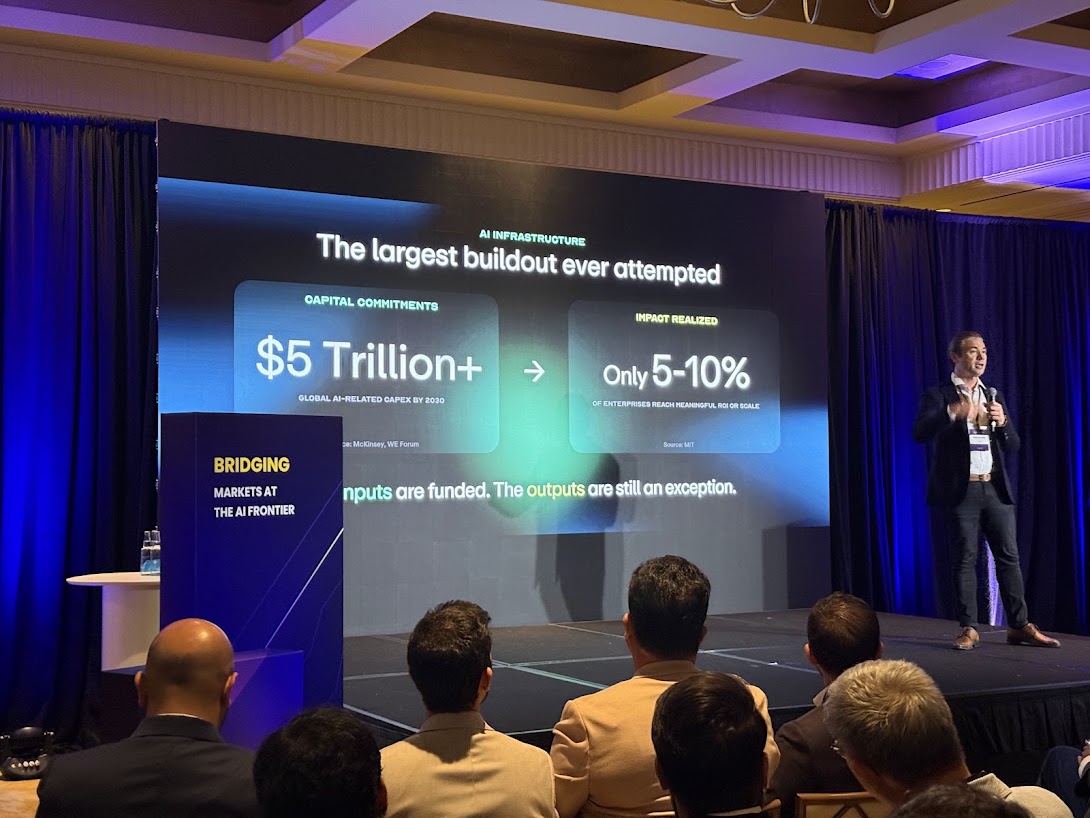
Amin's opening slide was the reason for the gap: more than $5 trillion in projected AI capex against 5 to 10 percent of enterprises reaching meaningful ROI. His three gaps were access, since compute is sold out and not to the enterprise; ownership, since rented intelligence does not know your business; and distribution, since the last mile is still hand-built. Rochkind's advice fits inside that: spend scarce engineering on new AI products rather than rebuilding the ERP, since the token costs alone will likely exceed the savings. Shukla's closes it: the next six months are about which model is right for a given job, and not everyone needs the frontier.
To governments and regions
Keep the productivity onshore. Taneja's warning was that if a nurse's salary abroad becomes a subscription to a Valley AI company, the services sector hollows out the way manufacturing did under the last globalization. His firm's answer is end-to-end: General Catalyst owns a gas site and a hospital and is working the chain from methane to power to inference to an AI nurse calling a patient in Ohio.
Seed the venture ecosystem and let it compete. Rochkind's model is Israel, where the state funded roughly ten venture firms, and he credited PIF as a validator whose signal carries weight in sectors like gaming.
Put the regulator in the room. Alswaha's own demonstration. He asked the head of the CST to stand and take questions, recounted an investor complaining the previous day about regulatory predictability, and asked when that investor had last had a G20 regulator in his office. His stated aim is to move from red tape to red carpet.
To investors
Taneja described venture as commoditized and said that if returns were the only goal, the obvious move would be to put all the money in Anthropic. General Catalyst has instead gone seed-first and bought firms to establish presence in India, MENA, and Europe. Younis's description of the alternative, a fund that takes a small tax on every technology company on the planet, was that it is a hollow way to do business. Shukla's practical version: invest in what the vertical giants leave open.
What the kingdom asked for
Alswaha closed his keynote by recalling that he had opened with the Groq story, the inference bet Saudi backed when the company could not make payroll, and said the goal for the next forum is to be talking about a different company from this room. His offer was compute, customers, and capital, and his condition for the return trip was that the audience engage the delegation he had brought. Once we partner, he said, we partner for a lifetime.
#FrontierLeadersForum · #AIInfrastructure · #Sovereignty · Deep Tech · #SaudiArabia