
Two kinds of startup
Many of the physical AI startups I meet in Silicon Valley are funded to move fast. They raise capital, build teams, and use their runway to win the first factory, fab or hospital deployment that will validate the technology. Speed comes first, and proof follows.
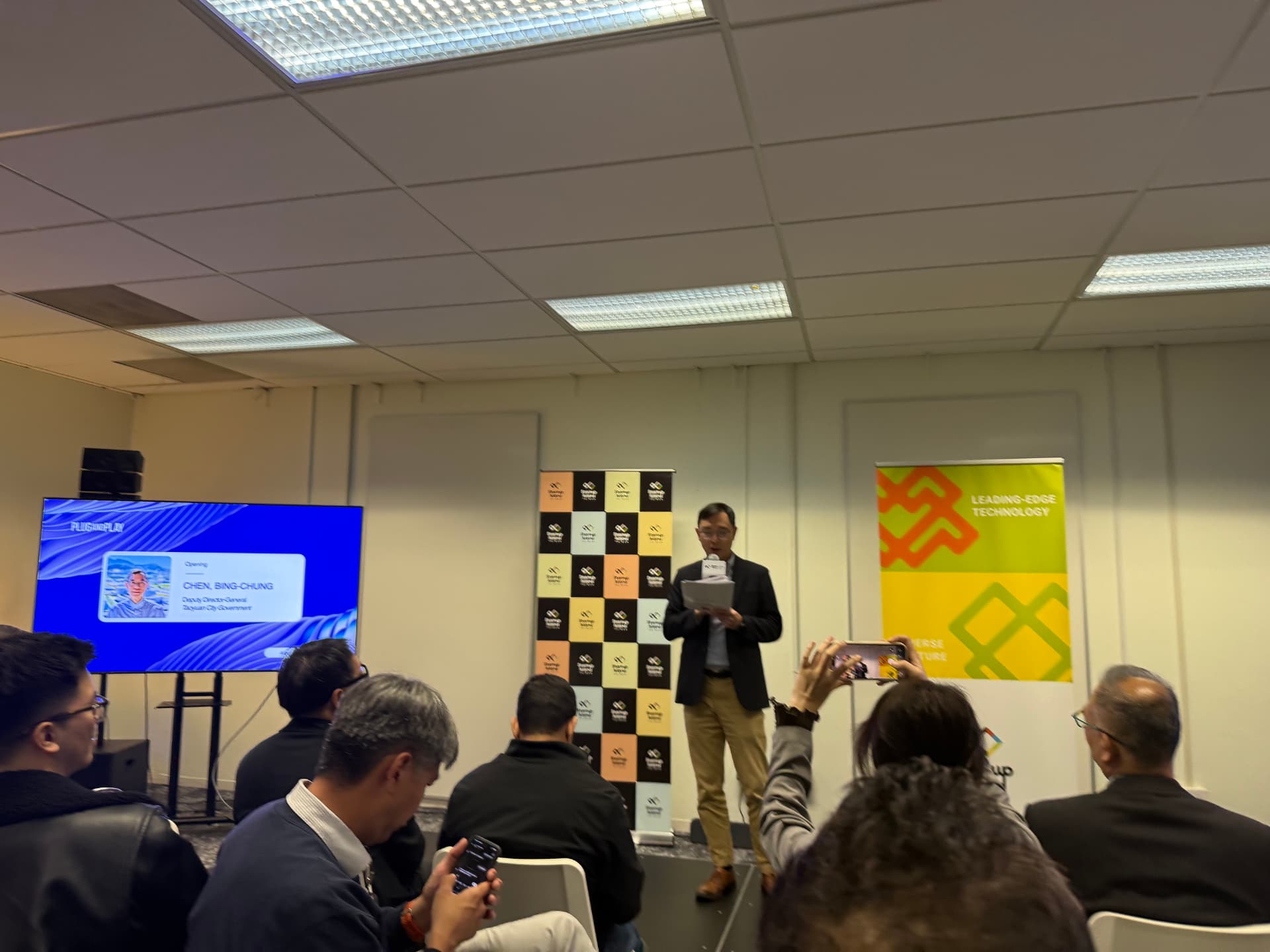
On Monday evening at Plug and Play, five Taiwanese startups presented the reverse sequence. The event was a founder and investor happy hour hosted by Plug and Play Taiwan and the Startup Island Taiwan Silicon Valley Hub. One founder had cut a packaging design cycle at ASE from three months to four hours. Another listed deployments at TSMC and Micron. A third reported results from a randomized trial of its ICU software.
They had validation first. What they came to Silicon Valley for was a faster path to selling it internationally: capital, US customers and pace.
In my physical AI work I keep returning to one line. Investors pay for speed, buyers pay for proof, and startups have to deliver both. The Taiwanese founders in the room arrived holding the half that usually takes longest to earn, built on know-how picked up inside Taiwan's fabs, factories and hospitals.
Three hurdles, all of them physical
Jeremy Lai, Investor at Plug and Play Taiwan, opened by explaining why Plug and Play started a Taiwan program in 2025. Physical AI has been a talking point for several years, he said, but scaling it is still hard. He named three hurdles.
- Hardware has to work as a system. Robots can be assembled from off-the-shelf parts. Making them run consistently in the field, on real data, is a different problem. By Plug and Play's numbers, about 75% of robotics total cost of ownership goes to setup and re-engineering.
- Compute is hitting physical limits. The constraint has moved from efficiency to memory to power. AI server power density is expected to rise 11x in five years, to the point where one rack draws as much electricity as dozens of homes.
- Prototypes have to scale. Some manufacturing will come back to the US, but much of it will stay outsourced. Jeremy sees Taiwan, Japan and Korea carrying most of that work.
None of these yields to a better model or a sharper demo. Each one is worked through by people who have integrated hardware on a factory floor, managed heat inside a dense package, or taken a prototype into volume production.
That is the experience Taiwan has in depth. Jeremy's case for the island rested on three things: engineering density across semiconductors, electronics and precision hardware; a supply chain so tightly packed that the local joke says you can find any component within a short moped ride; and a pool of technical founders who have not yet been widely discovered.
What the proof looks like
Three of the five pitches show the pattern clearly. Each company found its first serious customer inside Taiwan's own industrial base, then came here.
Neuroshine: the fab as first customer. Neuroshine builds AI-native thermal and warpage design for advanced packaging. Its co-founders are Prof. Jonny Yu, the CTO, who came out of MIT, and Sonic Lin, the CEO, who came out of TSMC. Their starting observation is that simulation eats about 90% of a packaging design loop, and one iteration can take more than three months.
Working with ASE, they took that iteration to four hours and produced a first cold-plate design in three minutes. They report under 2% maximum error against experimental measurements. Behind those results sit four contracts in progress, including ASE and ITRI, and six active POCs that include AMD, MediaTek and TSMC.
BY-Aitech: deployment is part of the product. BY-Aitech moves machine diagnosis into the sensor itself. A typical factory sends raw vibration data through four or five layers of hardware before anyone decides anything. BY-Aitech's edge AI chip runs 20 fault models plus remaining-useful-life prediction at the machine, and it claims 35 to 40% lower communication hardware cost as a result.
The slide that stood out to me was the company's list of deployments: TSMC, Micron, UMC, ASE, China Steel, Taiwan High Speed Rail and Hong Kong International Airport. Installation, integration and maintenance by the company's own engineers is listed as one of the four parts of the offer. That is the system-integration hurdle from Jeremy's talk, handled as a line item.
Huede Healthtech: evidence before expansion. Huede predicts acute kidney injury in ICU patients 24 hours ahead. It runs inside the hospital's existing records system through SMART on FHIR, with no new hardware. In a randomized trial presented at a 2026 medical conference, the company reports that AKI incidence fell from 30.9% to 21.05% with the software in use. The software carries Taiwan FDA Class II clearance and ISO 13485 certification.
The other two companies followed the same order. Taiwan Ruomei Technology reported temperature drops from its passive photonic cooling coating across laptops, AI glasses and chargers. Speculum AI, which builds a runtime stability layer for AI systems, reported a POC evaluation underway with a major Japanese system integrator.
The proof was not all the same kind. Neuroshine and Ruomei showed technical performance, BY-Aitech showed production deployments, Huede showed clinical and regulatory evidence, and Speculum showed early enterprise pilots. None of that guarantees a repeatable business. Each company had still moved past a pitch built on what the technology might do someday.
The know-how behind the brand names
Jeremy described much of Taiwan's technical talent as having worked behind large brand names, at TSMC, UMC and the other major semiconductor and electronics companies. More of those engineers now want to start their own companies. Plug and Play's sourcing pitch is built around them: people who may not arrive with a product idea, but who understand a market from the inside.
The teams on stage fit that description. Neuroshine's CEO came out of TSMC. BY-Aitech's CEO, Arthur Lu, worked at Foxconn, Delta and Advantech, and its VP of systems engineering, Brian Chien, spent more than 20 years running factory IoT at YFY Group. Its AI and chip leads are professors at the University of Washington and NYCU. Taiwan Ruomei's technical consultants are NTHU professors.
What these teams carry is mostly tacit. It is knowing which pumps fail first, how a package warps under load, and what a fab engineer will accept before trusting a new tool. Taiwan has a word for this: 眉角 (méijiǎo), the small, unwritten details of a craft that only people who have done the work know to get right. That knowledge was learned on the line, and it does not travel in a datasheet.
What they came here for
None of these founders is slow at building technology. Neuroshine's whole pitch is about compressing months into hours. What they are short on is the pace of international commercialization, and that gap showed up in three places.
Capital. Jeremy was direct about it. Venture capital in Taiwan remains more risk-averse than in the US, so strong technical founders often lack the funding to go international. The rounds on stage were modest next to the proof behind them: Huede is raising $3M, Taiwan Ruomei a $5M Pre-A, and Speculum a $5M seed.
Customers. A reference at TSMC or ASE carries weight in Hsinchu and Kaohsiung. A US buyer still asks for a US pilot, a US qualification and, in Huede's case, US FDA authorization. Each of those adds time and cost that a Taiwan-scale round may not cover.
Pace. Several companies are sequencing Asia first. Speculum is opening a Singapore headquarters this month and a Japan office early next year, and is in the US mainly for investors and partners. Huede's near-term deployment plan is Taiwan and Southeast Asia. That order is sensible, but it means the US market moves on while they build at home.
The risk for a company with proof and a slow path to market is that it stays a local reference: respected at home, early in the US, and outrun by a faster competitor with thinner evidence.
What a bridge has to supply
Plug and Play describes its Taiwan model in four steps: sourcing overlooked founders, opening industrial access, providing commercial validation through its corporate network, and then investing. It has run four Taiwan batches with 44 startups so far. The Taoyuan City Government backs the program, and the Startup Island Taiwan hub, supported by Taiwan's National Development Council, works the same bridge from the Silicon Valley side.
From where I sit, the founders don't need more proof. They need help turning the proof they have into speed here:
- Translation. A Taiwan fab result has to be retold in a US buyer's terms, as cost, yield or uptime on that buyer's own line. Neuroshine's US POCs are what that looks like once it works.
- Rounds sized for the US. A raise needs to cover a US qualification cycle, not only the next phase at home.
- Time on the ground. Someone here has to compress the months between a first meeting and a signed pilot.
The bridge also runs the other way. Plug and Play is courting global companies that want access to Taiwan's supply chain for their next stage of growth. Taiwan brings manufacturing density, specialized engineers and demanding industrial customers. Silicon Valley brings risk capital, international buyers and people who know how to scale a go-to-market team. Connecting the two shortens the time between a technology that works on a real production line and a company that can sell it worldwide.