

Baser Potential, the AI implementation firm I co-founded, sells implementation as a service. We also build software along the way, including our own control plane for the agents we put into client workflows. What clients pay for is the implementation and the work it makes possible, and the control plane is how we deliver it. That arrangement raises a question the earlier pieces in this series did not ask. When software gets cheap, does the money move to the work the software does?
The budget next door
Software has always been sold into a small budget. Gartner forecasts worldwide software spending of about $1.44 trillion in 2026. The International Labour Organization estimates labor's share of world income at about 52%, which on the IMF's estimate of roughly $117 trillion in world output for 2025 comes to about $60 trillion. The world pays people about 40 times as much for work as it pays for software.
The same gap shows up inside one economy. In the United States, businesses invested about $750 billion in software in 2025, roughly 2.5% of GDP. Professional and business services contribute nearly 13% of GDP. A company that does part of that work reaches into a budget about five times the size of the software budget, before counting the labor inside every other industry.
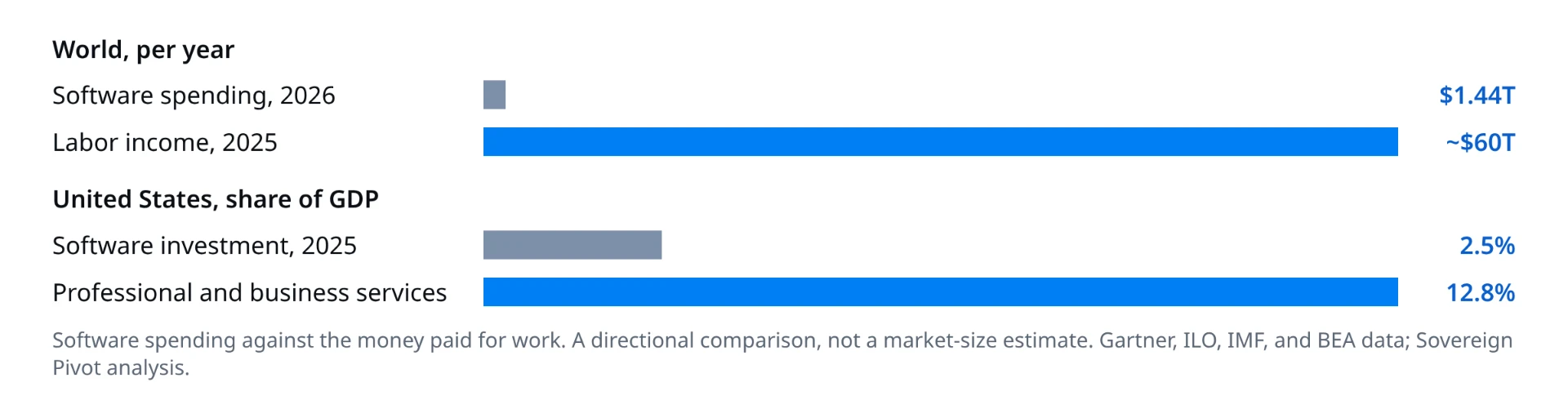
These figures are not a market-size estimate. Labor income includes the earnings of the self-employed, and it measures income, not spending a vendor can win. They show why completed work can draw on a much larger operating budget than software alone.
The price anchor moves
When a company sells software, its buyer compares the price with other software. When it sells finished work, the buyer compares the price with hiring someone to do it. That change in the reference point is what makes the larger budget reachable.
A finished job is different from a business outcome. A wall, a reviewed contract, or a closed set of books is a unit of completed work, accepted against a specification. A business outcome depends on much more than the work itself; fewer disputes or a lower construction cost are examples. Finished-job pricing charges for the first. Outcome pricing ties payment to the second, and as the enterprise piece notes, CFOs rarely sign those contracts because the two sides cannot agree on who created the value. The model that works today charges per completed job, with acceptance criteria and a service level, and that model is the subject here.
Monumental, which builds bricklaying robots in the Netherlands and the UK, sells finished brickwork. Contractors pay for the wall, priced the way masonry is usually priced, and Monumental is paid when the work meets specification. Downtime and defects are its problem, not the contractor's. Its co-founder Salar al Khafaji describes the offer plainly: "We're selling them a wall."
Crosby, a law firm built around AI for contracts, dropped the billable hour and charges per document. Its agents take a first pass, its lawyers review the work, and as a law firm it carries malpractice coverage. Lawhive, a UK legal technology company that already runs its own regulated law firm, bought the conveyancing firm Woodstock Legal Services in September 2025, extending the model into property work.
In each case the company accepts responsibility for the result, and that responsibility is what allows it to charge for the result.
A screen for candidate workflows
A simple comparison is a useful starting screen. Take one workflow in one industry and set what customers spend on labor for it against what they spend on software for it. When labor is many times larger, roughly ten times or more, the workflow deserves a closer look. The threshold is a rule of thumb, not a finding, and a workflow that passes it still has to answer four questions.
- Capability. How much of the labor can agents actually do today?
- Acceptance. Can the finished job be specified and accepted objectively?
- Residual work. How much human review and exception handling remains?
- Risk capacity. Can the provider absorb the liability and working capital that come with being paid on completion, when effort varies from job to job?
Bookkeeping for small businesses, routine contract review, and much of the paperwork on a construction project look likely to pass the first screen. Their answers to the four questions differ, which is why the screen says where to look and not who will win.
What comes with the bigger budget
The larger budget has a cost. A company paid for completed work takes on delivery risk, liability, and the insurance that goes with them. Its margins look more like a services firm's than a software company's, and physical work also needs machines and the capital to buy them. Earlier pieces described how investors repriced software once they began to doubt how long its revenue would last. A finished-job business may face a different discount, the one investors apply to services firms.
Whether AI-native service companies earn software economics will show first in their operating numbers. Gross margin and the human minutes each job still needs are the early tells, alongside how often work comes back for correction. Valuations will follow those numbers.
The price falls one level down
The hourly rate is a generous anchor while few providers can do the job. Once several AI providers can close the books or review a standard contract, competition is likely to push the price down. It moves from what a person charges toward what it costs to have an agent do the work. Selling the finished job escapes the pressure on seat prices and then meets the same deflation this series has described, one level down.
What resists that fall is much the same as what resists it in software. A rival may have to earn a license or a regulated status, and the provider may carry insured liability for the result. Physical deployment takes years to build. Data from completed jobs can make the next one more accurate, if the provider has the right to learn from it and does enough comparable work. Customers, lenders, and courts may already depend on the provider's record. Providers that hold those assets sit at one end of the barbell. Providers that offer the same work as everyone else drift toward commodity pricing at the other.
Who is positioned to move
Two kinds of incumbent start from opposite sides. Vertical SaaS companies hold the record, the domain rules, and the customer relationship, as the mid-market piece describes, but they have rarely been responsible for the work itself.
Services firms already are. Outsourcers, managed-service providers, accounting firms, and law firms sell finished work and carry contractual responsibility for it. Their difficulty runs the other way. Their revenue is built on their people's hours, and an agent that does the job in a fraction of the time cuts into what they bill. The software incumbent has to learn to carry responsibility, and the services incumbent has to price work that no longer takes the same hours. Which of them adapts faster will shape much of this market.
AI-native service companies start with neither constraint. The startup piece argued that a good software business may no longer be a venture-scale business. A company that sells finished work in a narrow market draws on that market's labor budget instead of its software budget, so it may reach a size a narrow software product could not.
Implementation firms like Baser sit between software and services. They build software, but the client relationship is defined by the work delivered.
Buyers decide how fast any of this happens. Finished-job pricing needs a deliverable a buyer can accept and a cost limit a CFO can sign, and the enterprise piece explains why buyers will insist on both.
What the finished job secures
Selling the finished job opens the larger operating budget. It does not, by itself, create a durable advantage. The value lasts when the provider also owns something competitors cannot reproduce cheaply. That can be regulated authority, a trusted performance record, distribution, the capacity to carry risk, or the right and the ability to learn from its own data. Without one of those, finished-job pricing is likely to follow seat pricing down.
Signals to watch
The series sorts evidence into three stages of economic change: cost reduction, bargaining and competition, and realized value capture. Most of the signals below would appear in the middle stage first.
| Signal | What it would indicate | Stage |
|---|---|---|
| A sustained wave of software companies acquiring regulated service providers | Software vendors moving to take responsibility for results | Bargaining and competition |
| Growing adoption of published per-job prices by software incumbents | Incumbents competing for the services budget | Bargaining and competition |
| Services firms repricing from hours to completed jobs | Services incumbents accepting lower billable hours | Bargaining and competition |
| Insurers writing coverage for AI-delivered work | Liability becoming a priced, transferable cost | Bargaining and competition |
| Per-job prices falling as providers multiply | Deflation reaching the services layer | Bargaining and competition |
| Gross margin, human minutes per job, exception rates, and claim rates at AI-native service companies | Whether finished-job revenue carries software or services economics | Realized value capture |
| Valuations at priced rounds and exits | How investors classify finished-job revenue | Realized value capture |
Signals that would show whether selling the finished job captures value, by stage of economic change. Sovereign Pivot analysis.
The question that remains
When a company is paid for the finished job, what does it own that the next provider cannot offer just as cheaply?
Also in When Software Gets Cheap
- What Got Repriced (The Market): Why technology lost its valuation premium, and who keeps the savings when code gets cheap.
- What the Corporate Buyer Decides (Enterprise): How corporate buyers decide what to build, what to buy, and what to renegotiate.
- What Still Stands in the Middle (Mid-Market): What vertical SaaS companies keep when agents take over the workflow.
- The Squeeze on Software Startups (Startups): When a good software business is no longer a venture-scale business.
- Who Keeps the Value When Software Gets Cheap (Closing): Findings, scenarios, and the signals to watch across the series.
Sources
- Gartner Forecasts Worldwide IT Spending to Grow 13.5% in 2026, Gartner, April 22, 2026
- World Employment and Social Outlook: September 2024 Update, International Labour Organization, September 2024
- World Economic Outlook, International Monetary Fund, October 2025
- Private Fixed Investment in Software, U.S. Bureau of Economic Analysis via FRED
- Value Added by Industry: Professional and Business Services as a Percentage of GDP, U.S. Bureau of Economic Analysis via FRED
- The Bricklaying Robot That Raised $32M and Built 100 Houses, Bricks & Bytes
- Training Data: Crosby, Sequoia Capital podcast with Ryan Daniels and John Sarihan
- Acquisition and US ABS First for Lawhive After Footballers Invest, Legal Futures, September 10, 2025
The header image is an AI-generated illustration of a mid-century scene, not an archival photograph.