
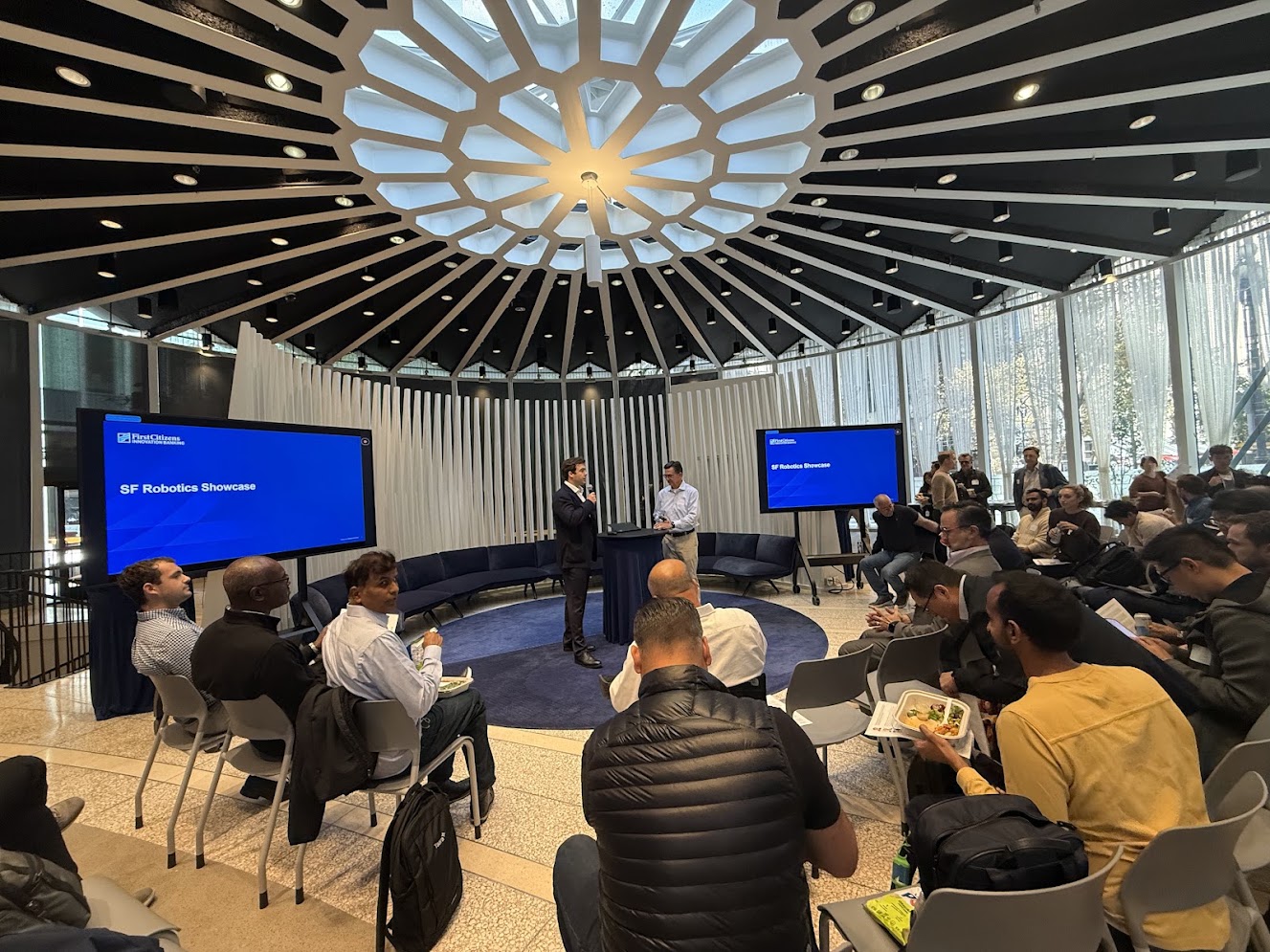
The event
On October 14, 2026, First Citizens Innovation Banking hosted its SF Robotics Showcase in San Francisco. The afternoon brought together a keynote from NVIDIA, pitches from thirteen startups, and a room of corporate leaders and investors.
The timing gave the event an extra layer. Eight days earlier, on October 6, First Citizens Bank had retired the Silicon Valley Bank name for its innovation banking division, which became First Citizens Innovation Banking. The division has served the innovation economy for more than 40 years, and First Citizens acquired it in 2023. The new brand launched with the line "Where Silicon Valley Banks." Opening the showcase, Gerald Brady acknowledged the change and said he expected that line to keep resonating with the community for a long time.
The showcase is now in its third year, and its format is deliberate. Startups pitch to the room as potential customers and partners, not as investors in a fundraising round. Many of the people attending were there to work out how to bring these technologies into their own companies, so the pitches leaned toward deployments, customer results and how to start working together. Each company had about five minutes, with time for questions. Members of the bank's team who cover frontier technology and robotics companies were in the room to help connect founders, corporates and investors.
The hosts
The showcase was hosted by Gerald Brady, Managing Director, and Max Montano, Senior Vice President, both on First Citizens Innovation Banking's Investor Coverage and Business Development team. Gerald gave the welcome, thanking the founders for their time and inviting investors to tell the team about any startup they wanted to meet. Max organized the showcase, ran the agenda and introduced the bank colleagues who work most closely with robotics companies.
One sign of how far some showcase companies have come: Axelera AI presented at the first showcase as a seed-stage company that had raised a little under $10 million. It returned this year after raising a $250 million round.
The keynote: NVIDIA's view of physical AI
Les Karpas, Global Head of Physical AI for NVIDIA Inception, opened with NVIDIA's view of where physical AI is heading. Inception is NVIDIA's program for AI startups, with more than 50,000 members in over 120 countries and no fees or equity taken. About 500 of those companies are ones NVIDIA considers strategic in physical AI, and that is where his team spends its time. He built the talk with AI: he gave ChatGPT 6 Astra a transcript of a colleague's lecture on the physical AI data flywheel and had it produce an animated presentation, which he was giving for the first time.
The opportunity is in the physical world. AI has started to reshape the roughly $5 trillion knowledge economy. The physical economy of factories, farms, logistics and hospitals is about $100 trillion. There is a lot to automate: 10 million factories, 4 million industrial robots, 570 million farms, 12,000 cities, 1.5 billion vehicles and 2 billion commercial cameras.
A robot is anything that senses and acts. That includes cars, drones and buildings. Once deployed, every robot also becomes a sensor feeding data back for training. Self-driving companies learned this loop a decade ago, and it is now spreading to every physical domain.
Real-world data is like fossil fuel. There is only so much of it, and the events that matter most are too rare or too dangerous to capture. World models and simulation fill the gap by generating variations of real scenes, such as turning day into night or one city's street into another's.
Three loops. He organized the talk around three feedback loops:
- The real-world loop: data trains a model, the model runs on a robot, and the robot's experience comes back as data.
- The agent amplifier: AI agents use 3D tools to build and refine simulations, setting up materials and physics and running them in parallel. In one example, an agent took a point cloud and photos of a factory and produced a 3D scene, designing 215 materials from a reference photo. Work that took months now takes hours.
- Real to sim: events from the real world, such as a collision on a factory floor, are rebuilt in simulation and varied thousands of times, so one incident becomes a full training curriculum.
The limit has moved from labor to compute. The constraint used to be how many simulation engineers you could hire. Now it is how fast you can close the loop between real and simulated.
He also made the case for common open formats, such as OpenUSD, so robotics, automotive and other physical AI data can be shared and trained on together.
The startups
The event was billed as robotics, but only about half of the companies build robots. The rest work on the layers that robots depend on: perception, data, models, compute and connectivity. That mix showed where the constraints in physical AI actually sit.
The companies
Robots, hands and factories
- Tacta Systems (Vikram Pavate, Co-Founder and CEO) builds robotic hands with no motors or cables in the fingers, which have run 30 million cycles under load, and a tactile sensor that can register anything from a feather to a punch and also senses temperature. The same sensors go into work gloves, so factory workers generate training data while doing their normal jobs. Tacta will start with a robots-as-a-service model in manufacturing and counts more than 300 factories and 300,000 workers it can learn from.
- Matter (Adi Prasad, Co-Founder and CEO) is an AI-native contract manufacturer building autonomous factories that serve as the training ground for MatterOS, its operating system for autonomous production.
- Ati Robotics (Saurabh Chandra, Founder and CEO) builds autonomous mobile robots for factories, including a new industrial humanoid, plus orchestration software and AI agents that move trolleys, bins and pallets. It has more than 50 customers, including 15 Fortune 500 companies, 250 robots sold, and operations across the US, India, Mexico and Southeast Asia.
- Anyware Robotics (Torsten Schreiber, Co-Founder and VP of GTM and Product) builds Pixmo, a mobile manipulator for trailer unloading, palletizing and machine tending. At Saddle Creek's site in Modesto, where trailers reach 140°F in summer, Pixmo has unloaded more than 800 containers and 9.1 million pounds of goods over 18 months with zero accidents, and Saddle Creek has expanded it to three more facilities.
- eBots (Zheng Xu, Founder and CEO) automates precision assembly in electronics and data center manufacturing, the area that is still largely manual. Its robots work at 22 microns, where industrial robots typically work at about 100, run vision at 409 frames per second, and reach 99.8% success in mass production. It is in production at Foxconn.
- Bonsai Robotics (Brendan Dowdle, CFO) provides an autonomy platform for off-road machines: fleet planning software, a perception stack, retrofit kits for existing tractors, and its own modular electric vehicle, Amiga. It has sold more than 400 machines and logged more than 25,000 autonomous hours across 42 environments with zero safety incidents. Its world model is post-trained on NVIDIA Cosmos 3.
- Walden Robotics (Adrien Gaidon, Co-Founder and Chief Strategy Officer) spun out of Toyota Research Institute and launched this year with $300 million from Toyota, Boeing, Samsung, NVIDIA, CoreWeave and Prologis. Its general-purpose robots work on a Toyota production line beside people, doing assembly, parts kitting, tool setting and machine tending.
Sensing
- Summer Robotics (Schuyler Cullen, Co-Founder and CEO) builds Kortx, a 3D vision system that captures continuously instead of frame by frame. Its framing was precise: robots take 70 to 300 milliseconds to react to what they see, while contact happens in 1 to 5. The same sensor records training data and guides the robot in real time. It runs today on semiconductor, industrial and surgical robots, including tracking bone during joint replacement.
- SiLC (Nirmal Warke, CTO) makes FMCW LiDAR on silicon photonics. Each pixel carries velocity, and multiple wavelengths and polarization can tell metal from plastic, wood or concrete. One chip platform covers 100-micron industrial inspection and long-range detection, with 20 km demonstrated. Its investors include Dell, Sony, Honda and Epson.
Models and data
- Elorian (Seth Neel, Co-Founder) is a frontier lab building models that reason over visual inputs natively instead of treating vision as an add-on. It is backed by $55 million. In robotics, an early use is turning first-person video into a timeline of labeled actions. In a head-to-head on one video, it caught all 10 key events where Gemini 3.8 Flash caught 6. Its first model is due later this year.
- Mecka AI (Mark Grinev, Special Projects Lead) captures how people do real work in factories, warehouses, stores and homes, using head and wrist cameras, 3D pose tracking and tactile gloves. Its slide summed up the problem: robots have roughly 100,000 times less training data than language models had. Mecka's goal is 100 million hours by the end of 2027.
Compute and connectivity
- Axelera AI (Alexis Crowell, CMO and GM, Americas) makes inference chips that put compute inside memory, designed first for the edge, where power is a hard limit and devices must run without the cloud. It reports up to 10 times the power and cost efficiency of GPUs and has more than 600 customers, including the European Space Agency. It returned to the showcase this year after raising a $250 million round.
- Taara (Mahesh Krishnaswamy, Founder and CEO) spun out of X in 2025 and moves data with beams of light: fiber-like speeds without trenching or radio interference, live in more than 20 countries. It is moving the system onto a photonics chip that could fit inside robots and vehicles.
Trends across the pitches
1. Data is still the bottleneck, and collection is moving to people. Mecka put it directly: teleoperation doesn't scale, human data does. Tacta and Summer both described wearables that record how workers use their hands, and Elorian is building models to label that video. Mecka said that eight months ago most people still expected teleoperation to be how robot data would scale.
2. Human oversight per robot is the number that matters. Several companies measured progress the same way. Anyware showed its intervention rate at a Fortune 500 site falling from 14% on day zero to 0.14% at site acceptance. Walden's model is fewer calls for help over time, with each call teaching the robot the task. Mecka named too much oversight per robot as the reason deployments don't yet pay off at scale.
3. Customers buy on unit economics. Bonsai showed the cost of an hour of tractor work: about $69 with a driver, $57 with retrofit autonomy and $29 with its autonomy-first Amiga. Anyware showed that 83% of customer value is hard savings in labor hours and overtime. eBots and Tacta both lead with yield and consistency.
4. Sensing is moving beyond the camera frame. Summer captures 3D continuously. SiLC measures velocity and material at each pixel. Tacta adds touch. eBots sees to 22 microns. Each argued that a model can only learn what its sensors capture.
5. Automation is leaving the cage. Ati's slide described it as automation breaking out of the yellow box: robots that used to weld inside safety cages now move freely, coordinated by software and AI agents. Walden doesn't ask customers to move a line. Anyware deploys the day it arrives. Bonsai retrofits tractors farmers already own.
6. A hard first market carries over to others. Bonsai built perception that works across orchards, vineyards and open fields, and is now running a blast-hole pilot with a large mining-services operator and working in defense. Summer's tracking works on factory parts and in surgery. SiLC, Bonsai and Axelera all serve defense customers alongside commercial ones.
Where they differ
Full stack or one layer. Walden builds everything itself because no available component is good enough yet. Axelera stops at the SDK and stays horizontal. Bonsai sits between, with its own software and both retrofit kits and its own vehicles.
Where the data comes from. Mecka and Tacta collect from people at work. Bonsai uses a world model to generate what its fleet hasn't seen. Walden and Anyware learn from their own robots in production.
How they sell. Tacta and Anyware offer robots as a service. Walden sells against KPIs the customer sets. Mecka offers partners data from their own operations and a path to deploying robots trained on it.
What was unique
Taara was the only company addressing how data moves, and it does so with light. Elorian is building a general model rather than a robotics-specific one. Tacta's hands have no motors or cables in the fingers. Bonsai was candid about incumbents: John Deere's large tractors carry about 60% gross margin, which gives it little reason to build smaller autonomy-first machines.
The closing argument: deployment is what scales
Adrien Gaidon of Walden Robotics closed the showcase, and his talk tied the afternoon together.
He argued that the "data pyramid" from language models does not hold in physical AI. The data his robots need is not on the web and cannot be bought. It has to be earned in production. He gave a comparison: about 20 million hours of video are uploaded to YouTube each month, while a fleet of a million robots would generate that much in under a day. His conclusion was that the only thing that scales in robotics is deployment, because the only thing that should scale is usefulness.
Walden's process follows from that view:
- Pick one task. The customer writes the test, using their own KPIs, takt time and safety standards.
- Real work from day one, on the existing line, beside the team, with a remote assistant on call.
- Fewer calls for help over time. Each call teaches the robot the task, and new tasks build on the ones before.
- People at the center. People direct the robots and focus on their craft.
Toyota's CTO, Hiroki Nakajima, described Walden's distinguishing trait as delivering robots that provide value from day one in real work environments. Adrien described the approach as the way out of pilot purgatory.
The keynote and the closing talk describe the same loop from two ends. Les focused on simulation and world models to fill the gaps in real-world data. Adrien focused on earning data through deployment. Together they describe one system: simulation gets a robot good enough to start, deployment produces the data no one else has, and real-world events flow back into simulation to cover what deployment can't safely produce. Bonsai is already running that loop, with a world model post-trained on NVIDIA Cosmos 3 alongside 25,000 hours of its own field data.
The same lesson applies to digital AI agents
Walden's approach carries over to software agents almost unchanged. Pretrained models already know what is on the web. What they don't know is how a particular company does a particular task: the exceptions, the judgment calls and the rules no one wrote down. That knowledge can't be scraped or bought either. It comes from running an agent on real work.
The steps map directly:
- Start with one task, and let the business write the test: acceptance criteria in its own terms, such as accuracy, turnaround and what counts as an error.
- Do real work from day one, inside an existing workflow rather than a sandbox.
- Escalate and learn. When the agent is unsure, it hands off to a person, and the correction is captured.
- Grow by curriculum: one task, then a bundle, then adjacent tasks.
Two differences matter. First, most companies don't retrain the underlying model, so an agent improves through updated instructions, skills, retrieved examples and test sets built from those escalations. That only happens if someone captures the corrections deliberately; otherwise the deployment data is wasted. Second, a robot that fails usually fails visibly, while an agent can fail quietly and sound confident. That makes the first task more important. It should be one where the output is easy to check, so every handoff produces a clear signal.
Software also has an advantage. Copying an agent costs almost nothing, so the fleet of a million that physical AI is still working toward already exists in software. The constraint is not how many agents a company can run. It is how fast the organization turns escalations into improvements, which is Les's point about closing the loop, applied to knowledge work.
Lessons going forward
- Customers judge robots on uptime against their own KPIs, not on demos. Pilots become production when the customer defines success.
- Track human oversight per robot, or per agent. It is the clearest measure of whether a deployment will pay off.
- Deployment is a data strategy as well as a revenue strategy. Companies already in production are building a lead in data that is hard to copy.
- Simulation and deployment work together. Simulation shortens the path to the first deployment, and deployment supplies what simulation can't.
- Physical AI depends on more than the robot. Sensors, edge compute, data movement and models each limit what robots can do.
- Start narrow, then expand. A hard first market or a single task builds the data and credibility to grow.
Thank you to Gerald Brady, Max Montano and the First Citizens Innovation Banking team for hosting, to Les Karpas for the keynote, and to all of the founders who presented.
A shorter version of this article, covering only the startup presentations, appears on LinkedIn.
#PhysicalAI · #Robotics · Deep Tech · #EnterpriseAI