
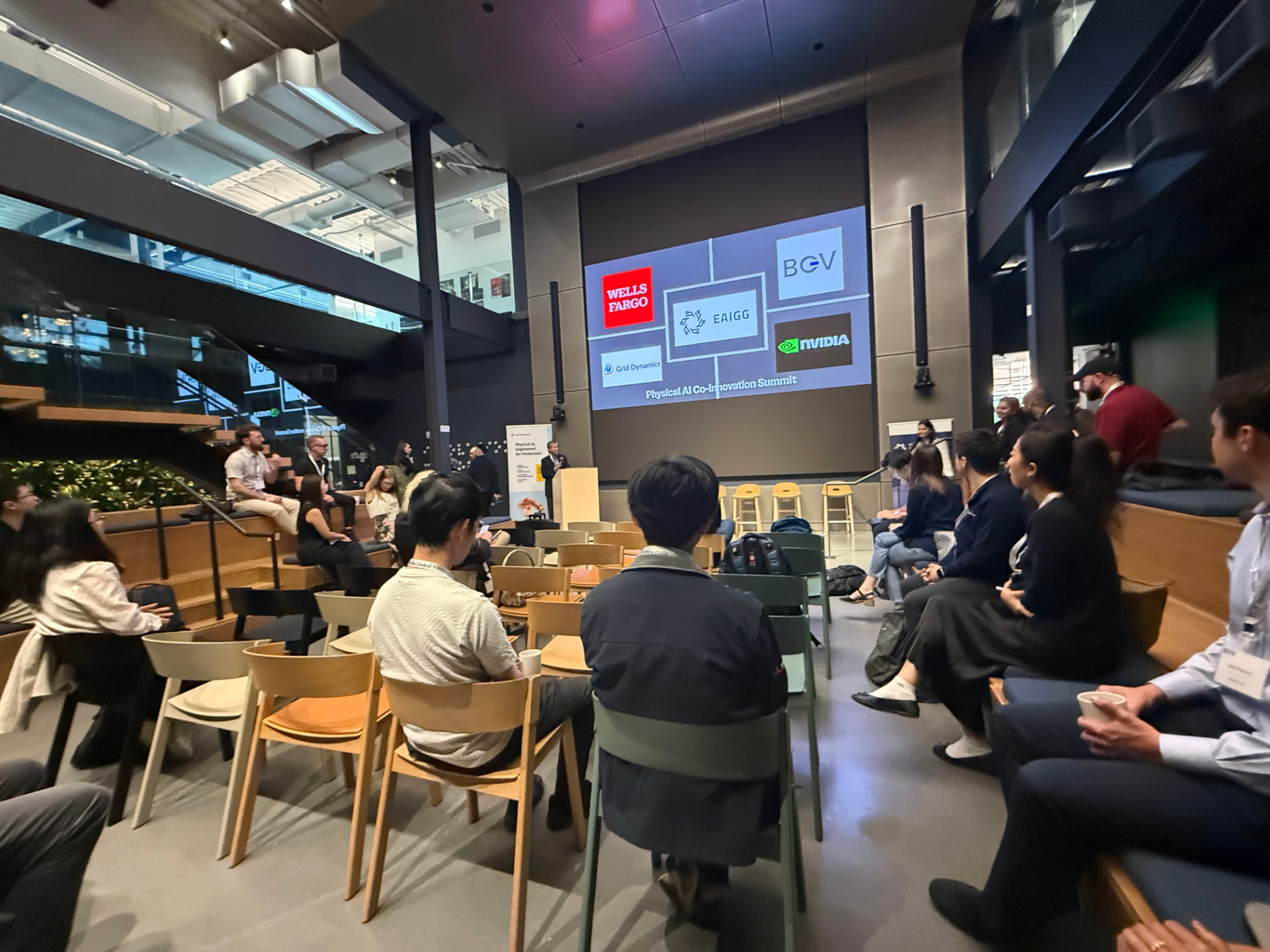
Seven startups pitched at the EAIGG Physical AI Co-Innovation Summit this week, to a room of enterprise leaders and investors. By the end of the afternoon I realized that none of them was selling a robot.
RoboForce comes closest. It builds its own machine, Titan, and plans US capacity for 12,000 units a year, yet its pitch is robo-labor priced against human work. Formic sells palletizing output at a flat monthly rate. Reframe Systems sells finished homes, EverestLabs sells sorting performance under a service-level agreement, and Archetype AI sells a physics model that runs on sensors a customer already owns. Foundry Robotics sells manufacturing capacity, and TorqueAGI licenses a model that moves between machines. In every offer, the robot is a component.
The layer between model and machine
What these companies build is an operating system for a class of physical work. Formic runs eight robot brands under one software layer. Reframe buys commodity arms from Fanuc, ABB and Yaskawa and writes everything else in-house, including the software that turns a customer order plus the local zoning code into instructions for workers and robots. Foundry reconfigures its assembly cells in software, so one floor can build battery packs, drone airframes and telecom hardware.
BGV's opening thesis named that position "the layer between the model and the machine." The startups reached it on their own, through deployment. Hardware and foundation models are commoditizing, while the software, edge-case data and operating discipline that keep a mixed fleet running through a shift change stay scarce.
Grid Dynamics marked the limit. After building a platform that combines learned policies with conventional robotics, the team reported that a universal low-code studio is "very challenging" and that focusing on a specific market is critical. The layer is valuable, and companies win it one class of work at a time.
Sold like infrastructure
Several of these companies carry reliability risk on the customer's behalf. Formic holds the equipment and downtime risk for its flat fee, and its customer Kari-Out raised output 25 percent without spending capital before signing on for twelve systems. EverestLabs guarantees performance and staffs a remote operations center around the clock. Formic funds its fleet with asset-backed debt rather than equity, citing 60 to 70 percent annualized returns on deployed robots. Lenders can underwrite that fleet the way they underwrite a data center.
Pricing follows the same logic. Archetype sells a fixed license with no token or usage charges, because a plant's sensors produce data without pause and consumption pricing has no ceiling a plant manager can budget against.
Why would a vendor take on that much risk? Buyers can't yet underwrite reliability themselves. One investor on the panel put numbers on the problem. Each additional nine of reliability costs about as much as all the work before it, and a robot at 80 percent success needs a person standing beside it around the clock. When proving reliability costs that much, the company able to prove it gets paid for the outcome.
Co-innovation is how deployment happens
By Formic's count, robotics and physical AI companies raised more than $27 billion in the past twelve months, and fewer than five companies have ever run a fleet of 100 or more robots.
Much of that gap sits on the enterprise side. The partner from SE Ventures, the fund backed by Schneider Electric, compared early talks between startups and business units to a tennis match. The startup asks for data to prove the model, the business unit asks for proof before handing over data, and the rally runs until someone asks what both sides would need if the technology worked.
NVIDIA's robotics ecosystem lead added that many new robotics companies end up acting as their own systems integrator. The labor story is more specific than "shortage," too. One Formic customer started 2025 with 250 employees, ended it with 250, and hired 360 people in between. The robots there fill churn.
Startups need production floors to collect the edge cases their models learn from, and enterprises need a partner willing to carry risk while value is proven. That mutual dependence is the practical argument for co-innovation, and the reason EAIGG built the day around it.
Verification earns permission to act
The third pattern ties physical AI to the governance questions enterprises now face with software agents. Foundry verifies each operation at the station that performs it and keeps an as-built record of every part, serial number and torque value, so a quality escape traces back in minutes. Archetype organizes its agents in four levels, running from detection through understanding and prediction before any agent is allowed to act. Formic reports that 85 percent of fleet events recover autonomously, which leaves people a designed role in the remaining 15.
None of these companies used the word governance. Each has still built the same structure, in which the system gathers evidence while the work happens and earns more authority to act as that evidence accumulates. Enterprises putting agents into finance or customer operations are working on the same question of how a system earns the right to act unsupervised. Asked for the most underappreciated category in physical AI, one panelist named safety, compliance and governance. The physical side may reach working answers first, since a robot that fails in a factory fails in plain view.
Sovereignty, and what it means for Asia
Archetype treats sovereignty as a product feature, keeping data and models inside customer infrastructure, air-gapped sites included. Policy is moving the same way. On July 28, the FCC placed new foreign-produced advanced robotic devices on its Covered List, which blocks the equipment authorization needed to import, market or sell them in the US. The rule covers mobile humanoids, quadrupeds and autonomous mobile robots, and leaves fixed industrial arms and already-authorized models alone. Because it turns on where a product is made, it reaches allies such as Japan and South Korea, as well as US companies that manufacture abroad.
For founders in Japan, Korea and Taiwan, the route into the US for a new mobile robot has changed. BGV's map put brains and compute in the US, bodies in China, components in Japan and applications in Europe, with deployment thin in every region. Components and the software layer stay open to Asian companies. A new mobile robot bound for American customers, though, now needs US production or a US manufacturing partner, which is the business Foundry and RoboForce are building.
When AI can act
Anik Bose of BGV closed the day with a framing that ties the patterns together. For the past few years, he said, the question has been what AI can think, and the takeaway from this room should be what happens when AI can act.
Once a model moves a pallet, frames a wall or sorts a waste stream, its mistakes cost money and sometimes safety, and someone has to stand behind them. The startups in the room have volunteered for that job. They sell outcomes instead of machines, run mixed fleets through every shift, and record evidence so the system can earn more authority over time. Financing, pricing and trade policy are reorganizing around the same question of who answers for a machine when it acts.
The investor panel was cautious about general-purpose humanoid model companies, which they see as capital-intensive with economics that don't yet work for venture. Most startups in the room made the opposite bet, on many kinds of bodies running under one operating layer. That contest is still open, and the companies in the room are betting that the nearer-term value goes to whoever keeps machines working on a customer's floor.
Each party in the room leaves with its own assignment. Enterprise buyers should ask any physical AI vendor who carries the reliability risk and what evidence the system produces while it works. Founders should expect their data advantage to come from deployment, which makes the partners who open their production floors as important as the investors who fund the model. Investors are underwriting something one panelist compared to semiconductors, where a design win takes years to land and is very hard for the customer to swap out once it does.
No one in that room can close the deployment gap alone, which is why EAIGG put enterprises, startups and investors on the same agenda. Robots will keep getting cheaper. The durable value will belong to the companies that customers trust to let those robots act.
#PhysicalAI · #Robotics · Deep Tech · #EnterpriseAI · #AIGovernance