
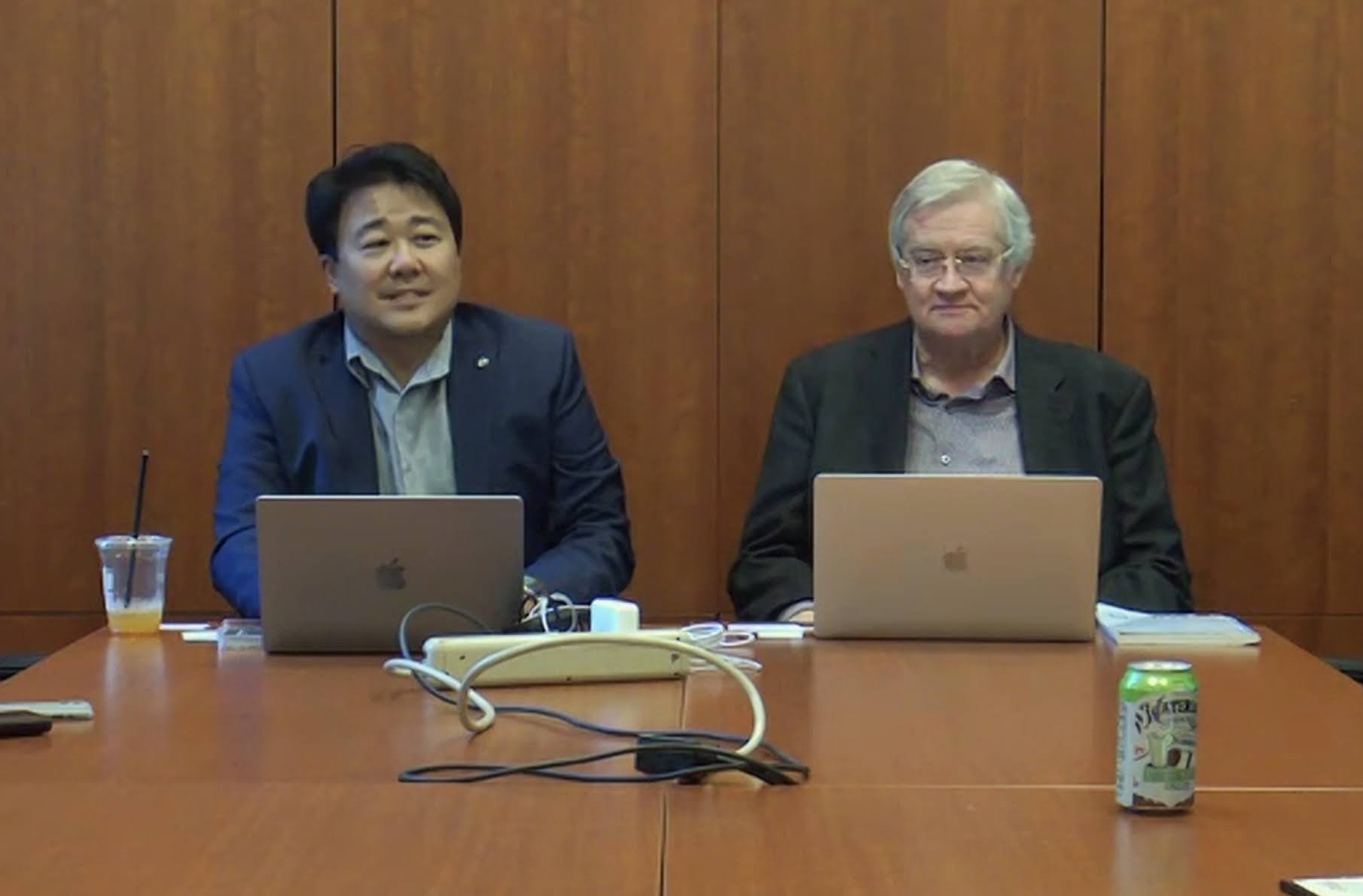
On September 16, the first member meeting of the year at the US-Asia Technology Management Center was held in Stanford's Knight Building. More people joined by Zoom from Japan. Founded in 1992, US-ATMC runs an industrial affiliates program that brings visiting scholars from Japanese companies to Stanford for a year or two. Professor Richard Dasher, who leads the center, invited me to speak on how AI is shaping Japan.
My talk was the smaller part of the afternoon. The questions that followed came from people whose companies will decide how AI lands in Japan, and they were sharper than most of what I hear in Silicon Valley.
Who was at the table
The visiting scholars and guests came from financial services, corporate venture investing, transportation, industrial manufacturing, enterprise IT, property services and impact investing, along with two universities and a healthcare consultancy. I am keeping companies and names out of this account, since the meeting was a closed one for members.
Several of the people at the table spend their days scouting Silicon Valley for a head office on the other side of the Pacific.
The talk, briefly
AI arrives in every country under different starting conditions, and Japan's are unusual. Japanese workers use generative AI far more readily at home than at work, and the gap tracks how rarely employers give explicit permission to use it on the job. Japan has largely stayed out of the frontier model race, yet its strengths in hardware, robotics and operational discipline count for more as AI moves onto factory floors and into supply chains.
To describe where AI-native companies are heading, I used Ikujiro Nonaka's knowledge spiral, the cycle in which an organization socializes, externalizes, combines and internalizes what it knows. Kaizen ran that loop on the factory floor, and AI-native companies are trying to run it in every function. My advice to corporate innovation teams was practical. Skip the wait for a company-wide mandate, pick one workflow you know well, and give it a clear owner and permission to test.
Nonaka came back in almost every question.
"Our core systems work. What changes the game?"
The first question from the floor came from the Silicon Valley research lead of a large Japanese financial institution. Japanese companies have built core systems efficient enough that nobody plans to replace them, and everyday AI tools help at the edges. She wanted to know where AI changes the game for a company like hers.
Legacy systems usually stay, and the gains come from redesigning the work around them. When supermarket scanners arrived, retailers expected faster checkout lines, and Walmart used the same data to see inventory across every store in real time. Fashion offers a sharper case. The traditional cycle had designers guess a season ahead, factories produce at scale, and stores discount whatever missed. Shein reversed the order. The company used AI to read demand from social media, produced small batches with many suppliers, tested designs in its app, and scaled only what sold. Both companies changed which steps existed.
For her company, the same logic points toward high-volume back-office processing, where the core system remains the record while the workflow on top of it gets rebuilt.
The fear of losing know-how
Joining from Japan by Zoom, an AI specialist at a corporate IT group named a worry I rarely hear in the United States. Anxiety slows adoption in Japan, he said, and the anxiety is specific. When AI takes over tasks, the tacit knowledge people built by doing those tasks goes with them, and when an operational problem arrives, nobody may remain who knows how to respond.
American workers fear replacement, and they have reasons. Klarna leaned hard on AI for customer service and later brought human agents back. The Japanese worry sits deeper in operations and needs a design answer.
In the room, I focused on which workflow goes first. Choose one the team already knows well, with a baseline you can measure, that has been done many times and stays internal. A customer-facing chatbot makes a poor first project, and so does software built from scratch. In operations where a failure carries real consequences, I would now add safeguards around the work itself. Keep people doing the hands-on step instead of only reviewing output. Route exceptions to people, and rotate staff through the automated steps so the skill survives the automation.
Winning without owning the model
Another participant pushed back on the physical AI argument. Publishers supplied much of the text that trained large language models, and the model providers captured the value. Why would Japanese companies holding physical and operational data fare any better?
The frontier labs carry enormous valuations without profits, so "winning" is still an open question. Open-weight models such as Alibaba's Qwen and Moonshot's Kimi are good enough for many tasks, cheaper to run, and easier to control. What matters more is whose improvement loop a company's data feeds. Pour operating data into a vendor's platform and the vendor's system gets smarter. Use models you don't own while keeping the data and the workflow in-house, and the company keeps the gains.
Dasher widened the question to specific domains, with medicine and manufacturing in the room. Vertical data is where a durable advantage forms. A medical model trained only on relevant data has less room to hallucinate about unrelated fields, and the data a company gathers from its own customers cannot be scraped from the internet. A university researcher at the table builds medical imaging AI that learns from small numbers of cases, which matters for rare diseases where large datasets will never exist.
Startups and large companies
A business school professor who studies startup ecosystems said Nonaka's model resonated with her research on large companies and startups, which bring complementary strengths. She asked what role startups should play.
AI-native startups follow a different order when they need a capability. They look for an off-the-shelf tool first, build it themselves if nothing fits, and hire people last. Pairing them with large companies works because each side holds what the other lacks. Startups need early pilots and customers, and corporations hold the domain knowledge, the data and the distribution. Speed causes the friction. A startup cannot wait out a corporate approval cycle, so an innovation team needs to settle who owns the workflow, what permission exists and which data is available before the first meeting with a founder.
An investor in the room asked the same question from the startup side. Technical founders are excellent builders with little experience selling to large corporations, so how early should go-to-market thinking shape the company? From the first day. Founders from PhD labs often want to perfect the technology before showing a customer, and by the time the product stops embarrassing them, the window has usually closed. AI has also changed how startups find buyers. Instead of emailing a thousand prospects, a founder can watch for intent signals. A company that just hired its first CISO is one; a startup that just raised a Series B and now faces SOC 2 audits from enterprise customers is another.
What Richard Dasher added
Dasher opened the discussion by pressing on the spiral, suggesting that a recursive, self-improving company need not be fully automated. I agree. The better picture is a human-to-agent ratio that shifts with the season and the customer mix. Silicon Valley spent the past year assuming falling token prices and rising salaries would push that ratio steadily toward agents. Frontier models are growing more expensive instead, and for some tasks a person is again the cheaper choice.
He also pointed to survey data showing that a large majority of top executives now use at least one AI tool, while workflows in the middle of the organization stay the same. "It's the boss using meeting summary," he said. The tool is convenient for the executive and leaves the work unchanged. Executives who watch a chatbot diagnose a car problem can conclude it will do any job, while employees wonder whether writing down everything they know makes them easier to replace.
He closed the discussion by asking what large Japanese companies should do when working with Silicon Valley's AI-native startups. My answer was that finding startups is the easy part, since every company in the room has access to the events and channels. The hard part sits inside the company, with its stakeholders, its approvals and its long lead times.
That gap has a place in Nonaka's model. A corporate innovation team in Silicon Valley does the internalizing and learns a great deal. The spiral breaks at socialization, when the team tries to get business units back home to adopt what it learned. The work needs a champion above the innovation team, not only inside it.
Two years or ninety days
As the room emptied, one of the visiting scholars asked me who takes the risk, and said change like this takes two or three years in Japan. Company-wide change may take that long. A single workflow with a clear owner and a measured baseline can be running in about ninety days, and the first result makes the second conversation far easier than any strategy document.
Every question that afternoon assumed AI was coming. People wanted to know how to adopt it without losing what makes their companies good: the know-how that lives in people, core systems that already work, and the trust of their employees. Those concerns are specific enough to solve through design, and Silicon Valley's AI-native startups need exactly the operating knowledge these companies hold.
My thanks to Richard Dasher and the US-ATMC community for a sharp and generous discussion.
#USATMC · #Stanford · #Japan · #AIAdoption · Deep Tech