
The value in AI is shifting. The early race was about access to the biggest, smartest general-purpose model. That race is largely over, or close to it, because everyone reaches the same frontier models within months of release. The value is moving to what you build on top of them: vertical systems tuned to one hard domain, and agents that own a whole workflow rather than answer a single question.
I spend a lot of my time working with companies on becoming AI-native, and across those conversations the same two vectors keep coming up as the ones that actually drive innovation: vertical AI and agentic AI. This morning at the 2026 Japan–U.S. Innovation Awards Symposium at Stanford, I watched both of them get confirmed in a single talk, from Vanessa Davis, Chief Product Officer of LegalOn Technologies. Start with the first vector.
Vertical AI: depth as the moat
Vertical AI is the bet that raw model capability, on its own, is table stakes. Foundation models are improving faster than almost anyone predicted, and once that capability is available to everyone, the model stops being the advantage. What's left is the domain scaffolding around it: the expertise, the evaluation standards, the ground truth a generalist can't get to. Depth becomes the moat because the horizontal layer is commoditizing.
Legal is close to a perfect test case for that bet, because the work is precise enough to demand real expertise and repetitive enough to eat enormous amounts of time. LegalOn's own survey puts a single contract at about 3.1 hours of review, and that's just the middle of the job. There's 15 to 30 minutes of intake and triage friction before it, and another 1 to 2 hours of obligation tracking after signature. Across a year, in-house teams lose thousands of hours to that kind of busywork.
Davis had the best line I heard all morning for why general models don't close this gap on their own. A general-purpose model reviewing a contract, she said, is an engine with no harness. It reads the whole document at once and tells you what it sees. It's fast, it sounds confident, and it finds the right neighborhood, but it misses the specific detail inside the clause. Real review isn't one question. It's dozens of interlocking checks run every single time. Is this clause present? Does this language clear this threshold? Are both standards met, or only one?
The harness is what turns that raw capability into something a lawyer will put their name on. For LegalOn that means legal intelligence as the core asset: more than 135 attorney-built playbooks covering over 10,000 legal issues, 100-plus market-standard templates, and coverage across 23 countries, with every output tied to a source reference and attorney-led testing so the risk stays with the lawyer and not the bot. In their 2026 contract-review benchmark, an ELO-style arena scoring around ten models across 21 precision-critical provision types, that scaffolding ranked first on every provision type, came out roughly 1.8 times more likely to be preferred than the best general-purpose model, and ran about 17 times faster. The specific numbers matter less than the principle behind them. High-stakes expert work needs a harness, and the harness is the defensibility.
Agentic AI: doing the work, not answering the question
That leads straight into the second vector: agentic AI, the shift from answering questions to doing the work. Researchers tracking how long a task a frontier model can finish on its own, start to end rather than just responding to a prompt, have watched that length roughly double every seven months. Two years ago these systems handled work measured in seconds. Today it's measured in hours. The unit of automation changes from "answer this" to "take this phase of the job and complete it, inside standards that keep it safe."
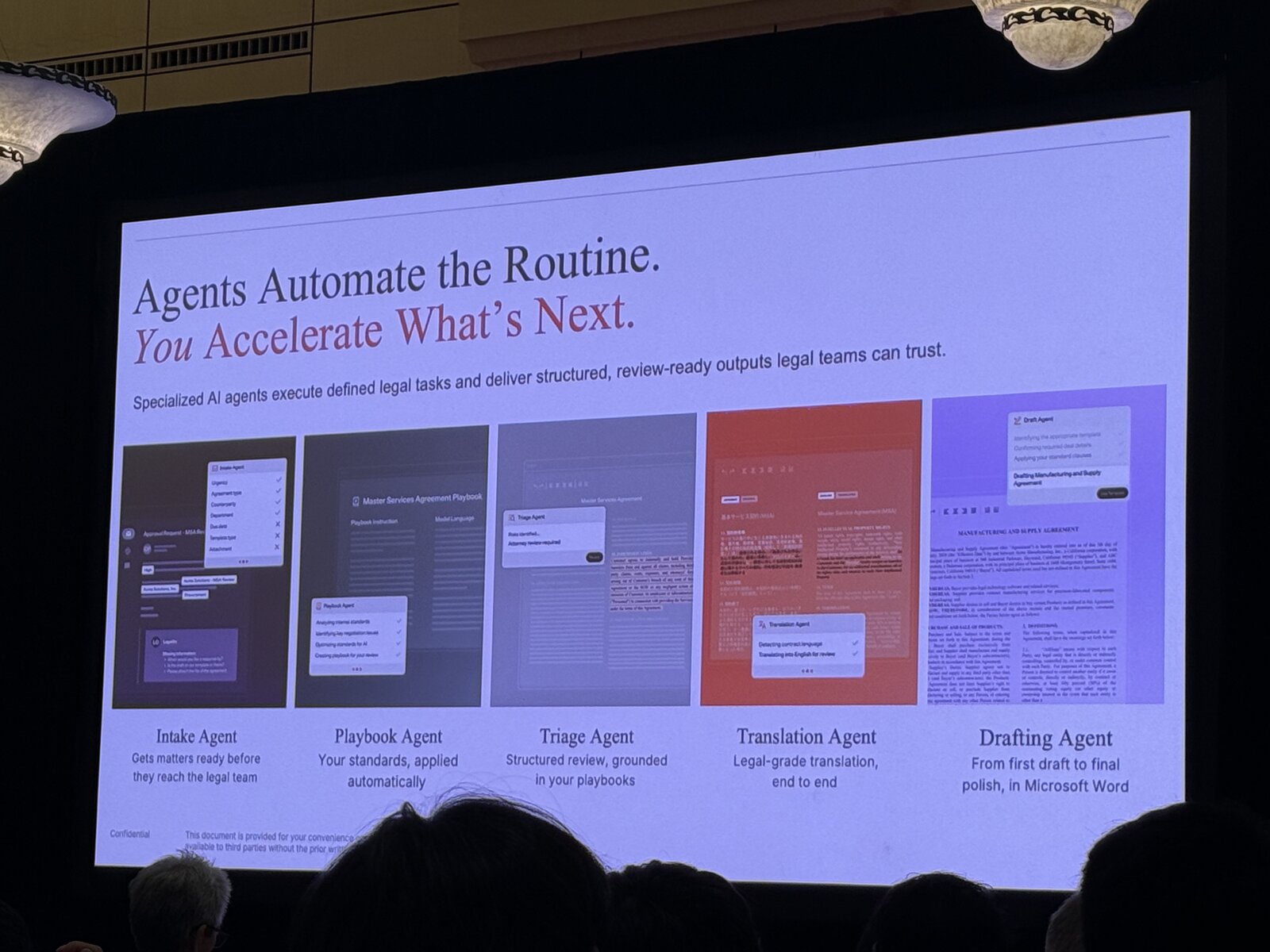
LegalOn's version of that is a set of narrow agents, each pointed at one part of the workflow and held to a specific standard. An intake agent that gets a matter ready before it reaches the legal team. A playbook agent that applies your standards automatically. A triage agent that runs structured review grounded in those playbooks. A translation agent for legal-grade translation. A drafting agent that takes a first draft to final polish inside Microsoft Word. Together they form an agentic layer that sits between the business team and the legal team, running where the work already happens, in Outlook, Teams and Slack. Humans stay in the loop, overseeing the workflow instead of being automated out of it. The customer results line up with the pitch: a hospital system cut contract review from hours to about 20 minutes, and one enterprise got first-pass NDA review down to roughly five minutes.
The growth lesson: earn the right to expand
There's a growth lesson tucked inside all of this too. The instinct with powerful general models is to go wide, every use case and every market at once. LegalOn did the opposite. They solved contract review in Japan first, reached about a third of the country's publicly traded companies, and only crossed into the U.S. once the proof was strong enough to travel. As Davis put it, they didn't decide to become a platform. The problem showed them that's what they needed to be. Earn trust on the hardest part of the job and you earn the right to see the next one.
So the thing I'm taking away from Stanford is the same pattern I keep pushing with the companies I work with. AI is going to touch your industry. The advantage won't come from the model everyone shares. It will come from building the vertical harness and the agents to own your hardest workflow. The only real question is whether you build it before someone else does.
Congratulations to LegalOn on a well-earned return, and to this year's Innovation Showcase and Emerging Leaders honorees. It's a good time to be building.
#VerticalAI · #AgenticAI · #AI · #Innovation · #LegalTech