
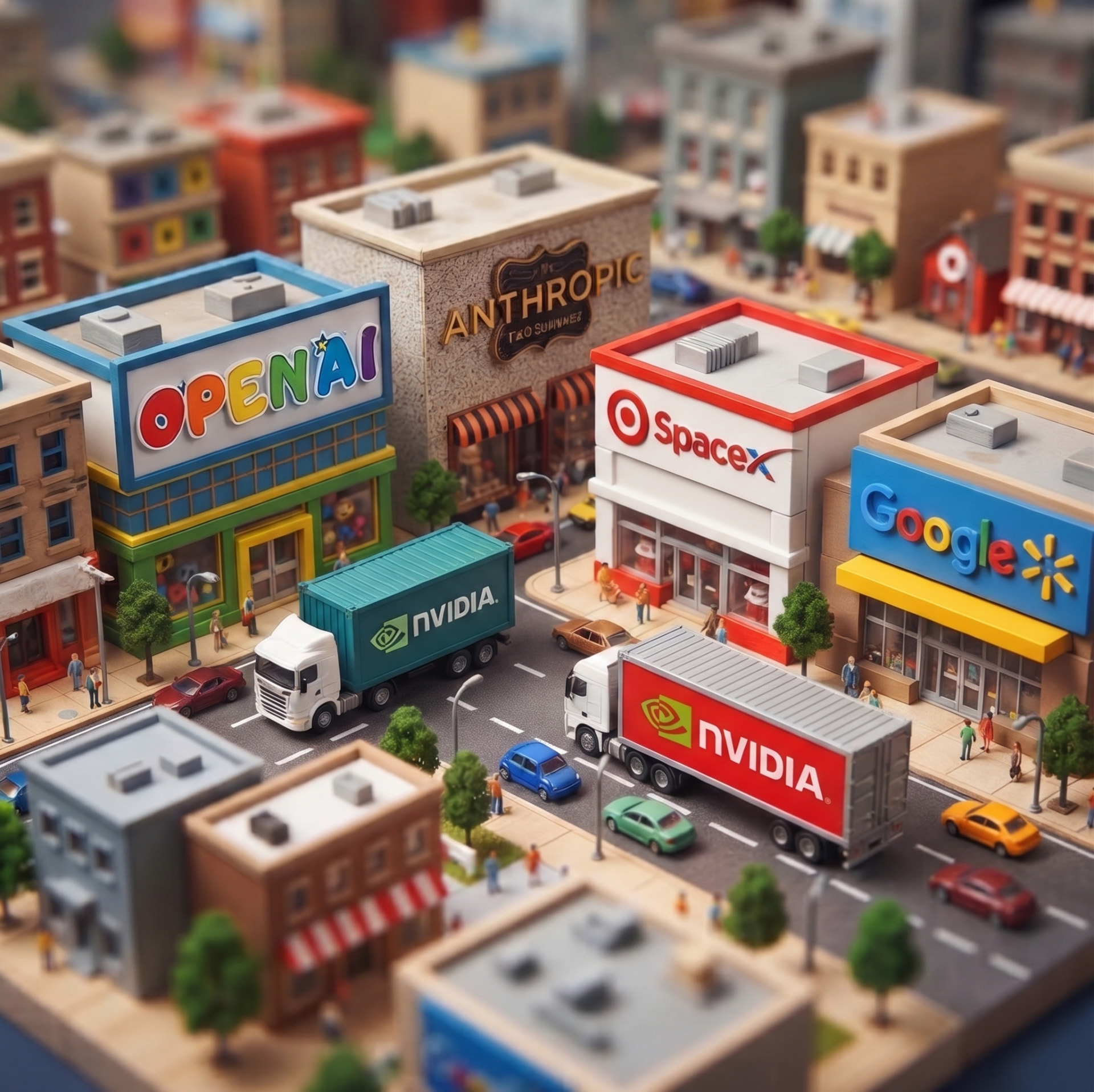
On Sunday, someone on X asked Elon Musk whether SpaceX planned to scoop up struggling AI cloud companies on the cheap. His answer was one word: "Pointless."
The same afternoon he explained why. Debt markets, he wrote, have almost entirely closed to companies without substantial revenue outside AI data centers. SpaceX had just signed a binding commitment for roughly $40 billion of GPU financing with an Apollo-managed entity, and Musk credited Starlink and launch revenue for getting it done. The 200-plus neoclouds, in his telling, face a wave of failures and consolidation.
We have seen this pattern play out before, in the toy aisle. Walmart never bought K-B Toys, because it never had a reason.
What follows describes a vulnerability. It isn't a prediction that OpenAI or Anthropic will fail. The labs are growing at a pace no toy store ever saw. Anthropic's revenue grew roughly twelvefold in 2025, and the company reported $11.5 billion for the second quarter of 2026. According to the Financial Times, that quarter was its second straight quarter of adjusted operating profit. OpenAI has a consumer audience that no retailer ever had.
The analogy also breaks down in a basic way. Toys "R" Us mostly sold toys that customers could buy somewhere else. OpenAI and Anthropic build the technology themselves, and they own the products, the brands and the customer relationships. They look more like Mattel and Toys "R" Us combined than like a retailer alone.
So the toy-store pattern applies only under one condition. If frontier AI becomes interchangeable faster than the labs can build durable customer relationships, a lab's economics start to look like a toy retailer's. The open question is how long differentiation lasts, and whether it lasts long enough to carry the commitments the labs have already signed.
How the toy stores actually died
The trouble for Toys "R" Us started with Walmart. In 1998 Walmart passed it as the largest toy seller in the United States, 17.4 percent of the market against 16.8 percent, according to NPD. Walmart got there by cutting toy prices during the holidays, sometimes below cost, because toys brought parents into the store and the parents bought everything else. Toys "R" Us answered with exclusives, which grew to about a fifth of its selection by 2003, and Walmart kept gaining share.
Two more blows followed. In August 2000 Toys "R" Us shut its own website and moved its online store onto Amazon, paying $50 million a year for exclusivity. Four years later it sued Amazon for letting other sellers into the toy aisle. Then came the 2005 debt-financed buyout by KKR, Bain Capital and Vornado, a $6.6 billion deal that left the company paying roughly $400 million a year in interest. When news of a possible bankruptcy broke in September 2017, suppliers curbed shipments ahead of the holiday season, and the company filed within weeks.
The specialists fell in order of balance-sheet weakness. K-B Toys, the second-largest toy retailer in 1999 and also a Bain buyout, went bankrupt in 2004 and again in 2008. FAO Schwarz filed twice in 2003. Toys "R" Us bought both brands out of the wreckage in 2009, the K-B name for about $2 million, and then followed them down.
Aisle one: the balance sheet
Musk's point is about credit, so start there. CoreWeave's bonds due 2031 briefly yielded above 16 percent this month, and the cost of insuring its debt passed 1,000 basis points. Meanwhile 42 equity analysts still carry an average price target more than double the share price. When the stock pickers and the bond buyers disagree that sharply, I tend to believe the bond buyers.
The frontier labs carry no buyout debt, and their obligations work differently. The 2005 debt paid for an acquisition, while compute commitments buy capacity the labs intend to sell. What the two share is a fixed bill set against uncertain demand. Anthropic's IPO prospectus, as reported by Reuters, lists about $518 billion in compute commitments, roughly 80 percent of them non-cancellable, including $111 billion with Google and $110 billion with Amazon. The Wall Street Journal puts OpenAI's commitments near $600 billion and reports that the company missed internal user and revenue targets earlier this year.
Anthropic's CEO has described the risk himself. A lab that buys compute far ahead of revenue, Dario Amodei told podcaster Dwarkesh Patel in February, could go bankrupt if growth comes in even slightly below forecast.
Aisle two: the loss leader
Walmart priced toys to sell groceries. Google bundles Gemini into Workspace and Android to protect search and cloud. Meta gave its models away to keep people inside its apps. Grok rides along with X and, increasingly, with Tesla.
For each of these companies the model is the bait. The specialist has to price its model as the whole business, and the generalist can price the same capability as a feature.
Aisle three: renting the competitor's shelf
Reuters reports that Anthropic routed 47 percent of its 2025 sales through Amazon and Google. Those two companies are also its largest outside investors, two of its biggest landlords, and direct competitors with their own models. According to the Journal's review of the filing, Anthropic says it struggles to get all the compute it wants because the hyperscalers increasingly treat it as a competitor. In May it agreed to rent the full output of xAI's Colossus 1 data center, now part of SpaceX, for a reported $1.25 billion a month through 2029.
OpenAI carries the same exposure on a different shelf. It spent years inside Microsoft's Azure, and its largest new landlord is Oracle, which signed a roughly $300 billion contract and is borrowing heavily to build the data centers that contract requires. One lab rents from its rivals, and the other rents from a landlord whose own balance sheet is under strain.
Toys "R" Us paid Amazon $50 million a year to sit on its shelf, and by 2004 it was suing Amazon for letting thousands of rival toy listings onto the same shelf.
The clearance bin
Toy retailers lived and died by the holiday season, which could account for more than two-fifths of their sales. A Furby was scarce in December and discounted by February, and the retailer that bought too many at full price wore the loss.
A frontier model ages in a similar way. It earns premium pricing for a few months after launch, until a rival ships something comparable or the same capability gets cheaper to serve. Older models keep earning revenue once the premium fades, and each run's research carries into the next model, but the launch premium that helps fund the next run shrinks with every competing release. Generalists face obsolescence too. They simply have more ways to earn a return on the same model.
The Chinese open-model labs add a second squeeze. Most of the world's toys were made in China, and in the last decade the factories began selling direct through Temu and AliExpress. Open-weight models from DeepSeek, Qwen and Kimi work in a similar way. They are good enough for a large share of tasks, nearly free to license, and available to any enterprise that wants to run them in-house. Each strong open release pushes frontier capability closer to interchangeable, the condition at the center of this whole comparison.
Why this isn't 2017
Specialists also survive sometimes. Best Buy outlasted Circuit City, and it did so by selling products complex enough that buyers wanted expertise. Enterprise AI is a complex purchase, which works in the labs' favor. Both labs have also filed for IPOs, which would strengthen their balance sheets without settling whether the underlying business holds up.
A fairer comparison might be Toys "R" Us around 1990, when it was still growing. It was dominant and admired, and the structure that later hurt it was already in place.
The shop-in-shop
Toys "R" Us still exists. WHP Global bought the brand in 2021, and by October 2022 there was a Toys "R" Us shop inside every Macy's in America. The name outlived the company, and someone else owns the customer.
AI already has its version of that ending. Inflection's team went to Microsoft, Character.ai licensed its technology to Google, and SpaceX holds an option to buy Cursor for $60 billion. One possible ending for a specialist under pressure is to become a department in someone else's store.
We should watch three signals. Watch the share of lab revenue that flows through hyperscaler channels. Watch whether the hyperscalers keep supplying compute on terms the labs can afford. And watch the price gap between frontier models and open models, because that premium has to cover serving costs, reliability, tooling and customer support.
We don't know how this plays out. The toy aisle took about twenty years to sort itself out, and the labs have advantages Toys "R" Us never had. We'll see how it goes.