
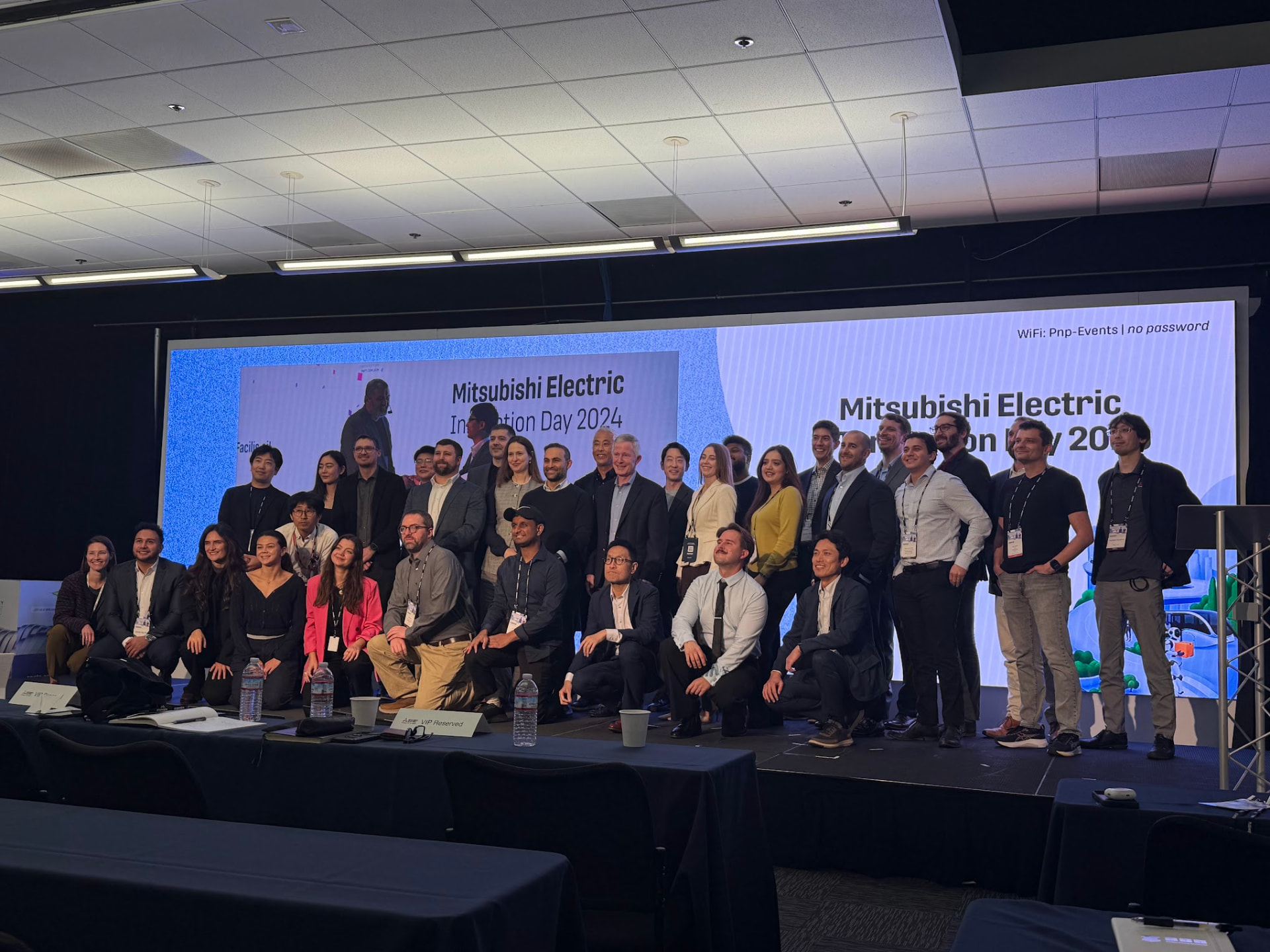
The event
On November 2, 2026, Mitsubishi Electric and Plug and Play hosted Mitsubishi Electric Innovation Day, a morning on physical AI and open innovation. The program moved from Mitsubishi leadership to a Stanford perspective on Japan and Silicon Valley, then to Mitsubishi's own open innovation work, a four-company startup showcase, and a closing leadership panel.
Kazunori Tanaka, President and CEO of Mitsubishi Electric Mobility, opened by video. The company has been trusted for reliability for nearly 100 years, he said, but the challenges ahead cannot be solved by any single company. Mitsubishi is not looking for vendors. It is looking for partners who challenge assumptions and move quickly.
One idea kept returning through the morning, from the Stanford talk to the startup pitches to the panel. The constraint speakers kept coming back to was access to how the work is actually done: the tacit knowledge held by the people on the genba, much of which is never written down.
Why Mitsubishi is looking outward
The business is moving overseas, and the US is central to it. Michael Corbo, Executive Officer, Head of Global Strategic Planning and Marketing, and Chief Representative for the Americas, said overseas business went from half of revenue at the end of fiscal 2025 to 55% in the first half of the current fiscal year, and he expects 60%, then 70%. The US is about 15% today. Mitsubishi is adding US factories for heat pump compressors, switchgear and data center cooling, and buying capability it lacks, including the industrial cybersecurity company Nozomi Networks. Energy, climate, labor shortages and geopolitical risk point it toward smart energy, automation, and defense and space, and "co-create" is now one of its three core values. A company can be first in market share today, Corbo said, and out of business tomorrow.
Innovation sits beside the businesses, not apart from them. Limor Spector, SVP of Innovation, Ventures, and Commercialization at Mitsubishi Electric US, joined the company recently and described what she sees with fresh eyes. The first is omotenashi, usually translated as selfless hospitality. In business it means anticipating a customer's needs and handling the details before being asked. She called it one of the company's quiet strengths.
Her team runs Serenity Street, with sites in Yokohama, opened last year, and Boston, opened a few months ago. She was specific about what it is not: an innovation team separate from the businesses, an exercise that ends in a demo day, or a sourcing team building long lists of startups. Business units, engineers and customers work there alongside startups, universities and partners.
She described three ways in:
- Partner: a Bay Area robotics company integrating autonomous delivery with Mitsubishi elevators, so a robot can bring food to a door on the top floor of a high-rise.
- Invest: Tulip, a no-code platform for frontline manufacturing, which Mitsubishi invested in less than a year ago and is now trying in its own factories.
- Acquire: Nozomi Networks, which she framed as buying intelligence rather than equipment.
The test across all three is whether one plus one equals three, and she favors mature startups whose products are already deployed with customers. Her closing request to the room was to challenge Mitsubishi and show it what it is missing.
The frame: tacit knowledge and respect for the genba
Dr. Richard Dasher of Stanford took on what he called the elephant in the room. When Tanaka asks for partners rather than vendors, the word means something different in Japan than it does in Silicon Valley.
Three differences that make the two sides complementary.
- Group orientation. In Japan, a partner means a team relationship that is both flexible and resilient, and ending a partnership is not a natural idea. Silicon Valley treats a startup more like an individual, expected to grow as fast as it can and then exit. If a new idea disrupts an existing company's business, the Valley doesn't mind. Japan tends to prefer stability and existing industry structure.
- Hierarchy. Hierarchy exists everywhere, but the Valley often sets it aside, with senior investors expecting young founders to think outside the box. In Japan it holds. That makes it harder for a startup to become established with a Japanese partner, which has no basis yet for trusting it. The startup has to demonstrate its trustworthiness as well as its capability, consistently.
- Indirect communication. In Japan, what is obvious to everyone goes unsaid. The result is what Japanese call anmokuchi (暗黙知), tacit knowledge. Dasher described it as powerful and widely misunderstood in the US. It is why Japanese startups often pitch poorly to American investors, and why American partners of Japanese firms spend time just working out what is going on.
How know-how moves inside a Japanese company. Large Japanese companies have run innovation cycles that would be hard to sustain in the US. Toray licensed carbon-fiber-reinforced plastic technology in 1971 and did not turn a profit on it until 1997; it is now a major material in aircraft and automobiles. Honda took 16 years to develop the passenger-side airbag.
Much of the transfer from R&D into a business unit happens through people. Because anmokuchi carries the unwritten knowledge of who does what, a person's trustworthiness goes with them when they move from the lab to the business that takes on the project. A startup has none of that. No one there has known it for 15 years. So, Dasher said, a startup has to show respect for the genba (現場), the actual place and practice of the work, and it has to be consistent.
Why companies on both sides need each other. Silicon Valley's large companies use open innovation to grow faster than their industries, because internal R&D will always lean toward improving existing operations. Dasher called this two-handed approach ambidextrous innovation. Large companies work with startups precisely because startups think differently.
Japan leads in the Valley by one measure: of the 300-plus foreign corporate innovation outposts there, more than 90 are Japanese, representing more than 60 companies. But many have not been getting the benefit. The outposts struggle to get headquarters' attention without an event big enough to fit what the company already cares about.
Each side wants something different. Japanese companies want to take part in value creation, often as limited partners in venture funds, and a window into new technologies and threats. Startups want capital, strategic investors who bring more than money, famous reference customers, and above all access to Japan's market, supply chains and distribution. The Japanese side fears locking into a company that may not last, or that gets acquired by a competitor. The Valley side fears slow decisions. Dasher's answer was that the slowness comes at the start. By the time a Japanese company is ready to work with a startup, everyone inside knows, and it can move quickly.
Physical AI is where the two fit. The hardest problem in physical AI, he argued, is scaling from a pilot to production. A model trained in a constrained setting on carefully curated data has to work in a messy environment, alongside existing equipment, within limits on size, weight, power and cost. That is where Japanese industrial depth and Silicon Valley's appetite for change complement each other.
His advice to Japanese companies:
- Speed up headquarters' acceptance of projects and build a portfolio mindset.
- Connect directly with the people whose jobs depend on strategic direction, and send targeted reports rather than general ones.
- Look at neighboring businesses, not just current ones. Honda Innovations built this kind of framework, helped by the memory of introducing Uber to headquarters, which passed on it.
- Stay involved after handing a project to Japan, so no one inside drags their feet and the startup keeps working on real-world scale-up rather than settling into the slower pace.
Dasher was describing how trust moves inside Japanese companies. The same idea describes physical AI's data problem. What a robot needs to learn is largely what experienced workers know and never write down: how a part seats, how much force a material takes, what to do when something is slightly off. That is tacit knowledge from the genba, and the rest of the morning was, in different ways, about how to get it.
Three ways Mitsubishi is working with startups
Yuta Tsukagoshi, Development Manager for Mobility on Mitsubishi Electric's open innovation team, framed the next part of the program as taking proven technologies into new domains by co-creating with startups. He showed three routes: from mobility into health, from the factory into a co-creation field, and from mobility into every industry.
Outbound: a car sensor finds a medical use
Mitsubishi's driver monitoring system does more than check whether a driver is watching the road. It also reads vital signs such as heart rate, respiratory rate and temperature, without contact. The team believed the technology could work in healthcare but had no healthcare pipeline, so it asked Plug and Play to help.
Plug and Play set up a one-hour webinar for healthcare startups, and more than 20 raised their hands afterward. One stood out: Amnion Life, founded by Dr. Amir Fassihi, a physician. Amnion is building an incubator for very and extremely preterm infants that keeps the body in simulated amniotic fluid with the head above it, and has FDA Breakthrough Device Designation. Today's NICU infants carry adhesive ECG leads, pulse oximeters and temperature probes. Their skin is so fragile that removing an adhesive can take skin with it, and in a fluid environment wires are not an option at all. Contactless sensing is meant to address both.
Kelly Rickert, Director of Sensing and Data Solutions, explained why the team went outside. Its experience is deep but concentrated in automotive, which can be an echo chamber. What it lacked was proximity to the problem. Rickert also described what the sensing is for. Machines are becoming more automated, and people need to trust them. Giving a machine human context, she suggested, may be the closest thing to machine empathy.
Inbound: the Diamond Room
Derek Johnson, Production Manager at Mitsubishi Electric's Center for Innovation and Manufacturing in Mason, Ohio, presented the Diamond Room. The factory wants to become a smart factory quickly, but moving too fast puts safety, quality and uptime at risk. The Diamond Room is meant to resolve that: a controlled incubation and validation space inside the factory, next to the main alternator assembly line, built to learn faster while controlling risk to production.
The candidate use cases include physical AI robots, sensing, machine monitoring, vision defect detection, autonomous mobile robots, and planning and scheduling. Startups get real equipment, real data and real constraints on a production floor of about 615,000 square feet, plus test space, infrastructure, and engineering and safety support. For Mitsubishi, the payoff includes solution packages built around its MELFA robot arms.
Every participant goes through five gates, with test and success measures agreed before any access to equipment or production:
- Apply: define the need and the baseline.
- Evaluate: agree scope, fit and resources; selection decision.
- Incubate: run a controlled trial; confirm it is safe to test.
- Validate: measure value and operational fit; review the evidence.
- Graduate: deploy, partner, or exit.
At every gate the trial can proceed, pause or stop, with test boundaries, safety clearance, quality checks and rollback as controls. Johnson stressed one detail: the trial runs beside the line it is meant for, so startup teams work with Mitsubishi engineers in person, not over video calls.
The first phase validates the Diamond Room itself, with a few external startups and several internal projects. A broader ecosystem of customers and partners comes after. The plan calls for program readiness in November and December 2026, startup selection in January and February 2027, trials from February to June, and graduation decisions in June and July, with dates subject to reconfirmation.
The Diamond Room is a practical answer to Dasher's problem. A startup that no one has known for 15 years cannot borrow trust. It can earn it on the genba, measured against a baseline the factory agreed to in advance.
Open-ended: a motor looking for new jobs
Takatoshi Kakuta, Head Engineer at Mitsubishi Electric Mobility, works on electric power steering (EPS), which Mitsubishi first mass-produced in 1988 and now builds at more than 10 million units a year. The team is looking for new uses for the motor. Its prototype is a training machine that replaces the weight stack with the motor and sets resistance in software, and two machines can be linked for a real-time tug of war between Tokyo and California. Kakuta also sketched a power-assist suit and a remote-operated fishing boat, described them as concepts, and asked the room what else a motor with that reliability record could do.
The startups: four answers to the data problem
Takehiro Ishiguro, Senior Open Innovation Manager at Mitsubishi Electric, introduced four physical AI startups the team is working with. Taken together, they gave four different answers to one question: where does usable physical-world data come from? Figures below are as each company reported them.
The companies
IndustrialNext generates it. Lukas Pankau, CEO and co-founder, led Autopilot architecture and later factory system architecture at Tesla, then sensing and compute architecture at Waymo. His co-founder Allen Pan worked on autonomous factory concepts at Tesla and on GM's autonomous systems, and CTO Gilwoo Lee led sim-to-real robot work at Meta. The company retrofits existing robots with its AI, sensing and compute, or supplies the full workcell, and moves from a fit assessment to a pilot to production, starting with one task.
It reports being in production in three factories, mostly consumer electronics: about 3 million laptops a year at run rate and more than 7 million smartphones assembled. One story stood out. A contract manufacturer moved an IndustrialNext station to a line for a new phone model the company had never seen, in a part of the factory it couldn't access, and had it running in about 60 seconds.
Its bet is simulation. Pankau was direct about why: no founder can ask a plant to shut down for a month to collect data. Real data also has limits. Coverage costs effort in proportion, operators solve the same task in different ways, rare failures are unsafe to stage, and new objects or lighting break policies trained only on real data. IndustrialNext rebuilds the real cell in simulation and trains there. In one test, 100 real demonstrations plus 1,500 simulated episodes raised success over 50 real trials from 52% to 86%. Its San Francisco arena mirrors dozens of physical workstations in simulation to find and close the gaps between the two.
Acumino captures it. Georgios Tzafis, Chief Commercial Officer, put the opposing position on a slide: you cannot simulate a factory; you need data from one. Acumino's data comes from the real station, during production, with the actual materials, from the worker who does the job, using the end effector the robot will use, and capturing motion, vision, force and torque. Its wearable and AR capture system is patented. Because the teacher is a worker rather than an engineer, data collection scales with the customer's workforce rather than Acumino's headcount.
Of the four, Acumino comes closest to Dasher's anmokuchi. Its product is a way to record what an experienced worker knows how to do and could not easily explain. The company frames the contrast as conventional automation scaling by removing variability, while it scales the variability.
It builds one model per task family, chosen for reliability. Tzafis told a story from a packaging plant: when he started pitching welding and molding, the plant manager stopped him. The plant only folds boxes, and she wanted 99% reliability on box folding. A layer called AcuBrain shares validated skills across robots, hardware brands and plants.
Its economics are aimed at integration cost. In one client example, conventional automation was quoted at €200,000 and 12 months, with €10,000 to €20,000 for each new product variant. Acumino's setup fee was €24,000, the station was running in 15 days, and a new variant needed only a new demonstration. It sells robots as a service at €5,000 to €9,000 per station per month, with KPI gates per phase and shared ownership of the data, and plans to move customers to software over time.
Conduit connects it. Danny Pereira, CEO and co-founder, grew up in his family's food manufacturing business and saw what it took to deploy a first robot there: integrators, consultants and hundreds of hours. His diagnosis is that nothing in the factory talks to anything else. Robots, PLCs, process equipment, building systems, material handling and business software each speak their own language, and operators reconcile the gaps by hand.
Conduit's answer is what it calls one factory language: a single platform with deterministic read and write control down to the PLC, connecting any brand of robot or machine and the software around them. It says it can stand up a browser-based digital twin of a factory in about three days, from live data rather than a heavy simulation project. Where data doesn't exist, Conduit builds the hardware, in Detroit: forklift localization, a six-in-one machine sensor and air-gapped edge compute.
Pereira cited three deployments. At Toyota, Conduit unified more than 200 robots of different brands across North American plants in under a month. At an automotive plant, it brought two vendors' AMR fleets under one control layer in 15 days and cut intersection congestion time by 64%, replacing an integrator that charged $14,000 per traffic-logic change. At his family's bread factory, it used existing CCTV cameras to score worker ergonomics and push better work instructions to the floor, and reports an 80% drop in safety incidents on the main line. The company has raised about $13 million and is in about 15 factories.
Nomadic AI curates it. Varun Krishnan, CTO and co-founder, described Nomadic as the understanding layer for physical AI. Robots and vehicles record far more than anyone can watch, and most of it is never used. Frontier vision-language models read a scene well but miss the physics of contact, force and timing. Nomadic segments footage into labeled events: for robots, every subtask by hand with contact force alongside; for driving, events confirmed across camera, LiDAR and vehicle telemetry, searchable in plain language.
Its argument is that curated, annotated data moves models more than raw volume does. It runs two businesses on one engine. As a toolmaker, it processes customers' own data, which is never sold. As a market maker, it annotates footage from fleets that opt in and sells it to model developers, with owners keeping ownership. Its pricing slide made the point: an hour of bulk robotics video sells for a few dollars, while usable, curated teleoperation data sells for $120 to $200. Mitsubishi Electric appears on its customer list.
What they share
None pitched its own robot as the product. IndustrialNext can supply a full workcell and Acumino delivers working stations, but each sells a layer that works across hardware brands: AI retrofitted onto existing robots, a skill layer across embodiments, one language across vendors, and annotation across any sensor stack. At an event hosted by a company that sells robot arms, that might look like tension. The panel explained why it isn't.
They all sell against integration and changeover engineering. Each pitch put numbers on it. IndustrialNext cited 4 to 18 months to design and commission a new line and up to four weeks to reprogram, against under a minute for a new part. Acumino compared €200,000 and 12 months with 15 days. Conduit compared an integrator's $14,000 per change with changes made in minutes. Nomadic pitched faster review at lower annotation cost. The expensive part of automation, as Acumino's slide put it, was never the robot. It was the engineering.
All four emphasized production over demonstrations. They cited phones and laptops on real lines, 200 Toyota robots, contracts with KPI gates, and paying customers on both sides of a data market.
Where they differ
What simulation is for. The word meant three things in one session. For IndustrialNext it is a training-data generator. For Acumino it is not good enough for factory reliability. For Conduit it is an operational mirror of the live floor. Nomadic works only from recorded reality. My read is that IndustrialNext fits best in high-precision, geometry-driven work like memory insertion and connector placement, where parts are known exactly, and Acumino in contact-rich, variable-material work like folding and packaging, where physics is hardest to simulate.
General or specific. Acumino argues that a general model is a bet on the field, while a task-specific model is a contract a plant can sign today. IndustrialNext starts with one task but describes a foundation model trained mostly on simulation data. Nomadic sells to the developers building general models.
Who owns the data. Acumino co-owns line data with customers, and calls access to live lines its moat. Nomadic keeps customers' own data private and runs a separate market where fleet owners sell footage. Conduit can run fully on premises or air-gapped. For a plant evaluating any of these, data ownership is a useful first question.
How they sell. Acumino offers robots as a service now and software later. Conduit sells a platform plus its own hardware. Nomadic sells tooling and data. IndustrialNext moves customers from pilot to production.
The buyer's test: the leadership panel
The morning closed with a panel moderated by Sobhan Khani, President of Plug and Play. The panelists were Masahiro Kaji, President and CEO of Mitsubishi Electric Automotive America, which runs the Mason plant and the Detroit sensing team; Mark Kuntz, COO of Mitsubishi Electric US, responsible for businesses including heating and air conditioning, elevators, semiconductors, robotics and satellites; and Ryuji Yoshinaga, Deputy Senior General Manager at Mitsubishi Electric Mobility, responsible for new business in Japan. Kaji introduced himself as the person a startup ultimately has to convince.
Why Mitsubishi invests. Kuntz described three concentric circles. The inner one is technology that raises throughput in Mitsubishi's existing businesses. His example was robots-as-a-service companies: largely a financing model, but one that needs AI for codeless programming, visual control and performance management. Mitsubishi invests because these companies let manufacturers without the capital budget buy robots, which means Mitsubishi sells more robots. That resolves the apparent tension from the showcase. Startups that make automation cheaper to deploy pull the hardware through.
The second circle is technology that raises customers' throughput. Mitsubishi has invested in a company that automates quoting for heat pump installations, from site survey through engineering, commissioning and ongoing performance. If installers work faster, Mitsubishi sells more heat pumps. The third circle is new businesses, ranked by how close they sit to a current one so the company can use its network, skills and scale.
A heat pump fleet as a power plant. Asked where Mitsubishi has a right to win in the US, Kuntz pointed to the virtual power plant. On peak days, he said, heating and air conditioning is the load at the margin, and networked variable-speed heat pumps can ramp from 0% to 150% of capacity, timed to the minute-by-minute value of grid capacity. Coordinating millions of devices that way is a job for AI. Mitsubishi says it has the largest deployed fleet of variable-speed heat pumps in the country and wants partners to help turn that installed base into an asset that earns. What it wants to avoid is more capital-intensive business.
People stay in the smart factory. Kaji described plants already changing what they make: Kentucky now builds compressors, and Mason is taking on factory automation and data center IT cooling. Changing a plant's portfolio is hard because each has its own way of manufacturing and thinking, and he sees digital tools as what bridges those differences. His picture of the smart factory is not lights out. Robots take repetitive and unsafe work, but people hold the production knowledge, and it takes a long time to transfer that knowledge to robots. So people stay, working with robots, and he wants them to be well and happy doing it.
The path from Mason to the market. Mason is working with more than 20 startups, Kaji said, with the aim of flexible operations rather than replacing people. A technology is measured first on Mason's own line, for productivity, quality, safety and flexibility. If it holds up, it goes to Mitsubishi's production sites worldwide. If it proves repeatable and scalable there, it goes to outside customers through Mitsubishi's factory automation business, which already has the customers and the sales network. His criteria for startups were the same: it has to work, it has to create customer value, and it has to be repeatable and scalable.
What Mitsubishi has to change. Asked how a startup gets from a first meeting to a signed program in months rather than years, Yoshinaga was candid. Large companies are designed to minimize risk, and startups are designed to maximize learning. For partnerships to work, Mitsubishi has to adapt too. He named three things:
- Faster decisions with clear ownership. A startup should know who can say yes, not just who can arrange the next meeting.
- Smaller, faster validation. Run a test and learn from real results instead of spending six months discussing requirements.
- Judging opportunities on strategic potential three to five years out, not only on fit with today's businesses, since breakthrough technologies rarely fit existing categories when they first appear.
What success looks like. Asked to finish the sentence "Innovation Day is a success if," Yoshinaga said: if today's introductions become tomorrow's partnerships, and those partnerships become future products. Kuntz took his answer from Dasher's ambidextrous innovation: Mitsubishi as one hand and its innovation community as the other, equally skilled, neither superior. Kaji said he didn't want only to be inspired. If he found one startup that could make one plus one equal three, and build a long relationship with it, the day would be a success.
Takeaways
For startups working with an industrial buyer:
- Earn trust against a baseline the buyer sets. A startup can't borrow the trust a Japanese partner builds over years, but it can show results against measures agreed in advance, on the buyer's own line.
- Price against integration and changeover cost. That is the cost every startup at the showcase said customers want to bring down, and the one buyers can measure.
- Settle data ownership early. The four startups handled it four different ways, and it shapes what a customer is willing to share.
- Design for repeatability across plants. A result on one line opens the door; a result that repeats across sites is what moves a technology to scale.
For corporates working with startups:
- Give startups access to the genba, with controlled risk. Real equipment, real data and engineering support, inside agreed boundaries, is what a startup can't get anywhere else.
- Name an owner who can say yes. Startups need to know who decides, not only who can arrange the next meeting.
- Run small tests instead of long requirements. Learn from real results rather than months of discussion.
- Judge opportunities on a three-to-five-year horizon. Technologies that matter often don't fit today's business categories when they first appear.
Japan as the proving ground
Yoshinaga gave the morning its widest frame. Japan is an aging society, and its biggest challenge is not efficiency but a shrinking workforce. That shifts the opportunity from automation to augmentation: technology that amplifies what people can do rather than replacing them.
He described what that takes. Sensing has to understand context, not just activity: a person's workload, fatigue, stress, attention and intent, so the system can help before a problem occurs. Robots have to become easier to teach, adapt and operate, because many in Japan still need significant engineering to deploy and maintain. And the pieces have to work together: sensing to understand what is happening, AI to turn it into a decision, and a robot to act on it. Over the next three to five years, he expects Japan to become the world's most important proving ground for human-centric AI and robotics, out of social necessity as much as business opportunity.
That brings the morning back to where Dasher started. As experienced workers retire and are not replaced, the tacit knowledge they carry from the genba is both what is at risk and what robots most need to learn. Easier-to-teach robots, worker-led data capture and sensing that understands people are all ways to keep it. The work ahead, for startups and buyers alike, is capturing that knowledge in ways the workers who hold it will teach and the factories that depend on it will trust.
Thank you to the Mitsubishi Electric team and to Plug and Play for hosting, to Dr. Richard Dasher, and to all of the founders who presented.
Shorter versions of this article appear on LinkedIn, one on Mitsubishi Electric's open innovation work and one on the startup showcase: Read on LinkedIn