
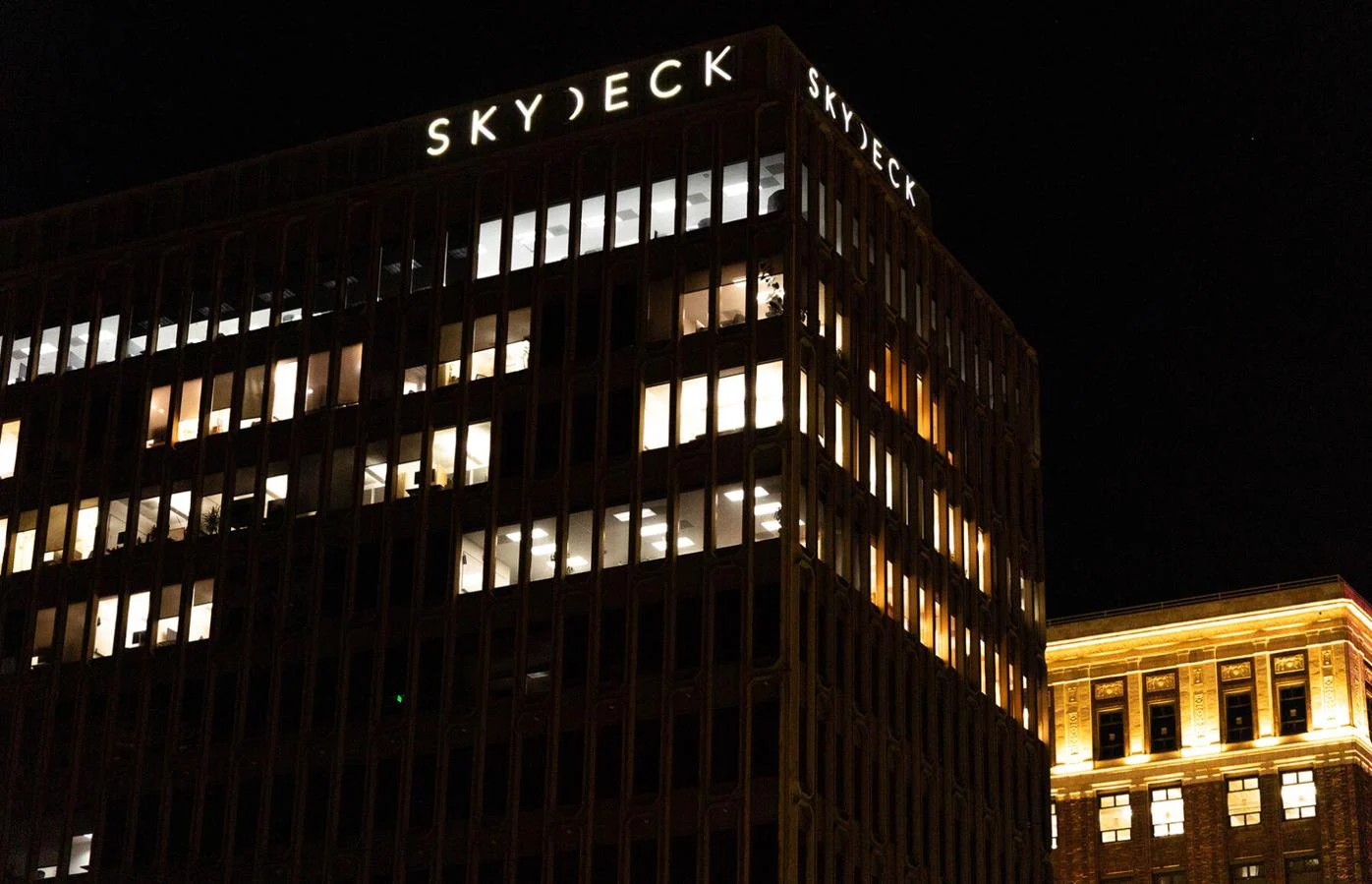
Berkeley SkyDeck selects its accelerator cohort through two live interview rounds held over a few weeks. In a recent batch, about 150 companies were invited to a first-round interview, and roughly one in three went on to a final.
The process rewards founders who are easy to understand quickly, who answer the hard question before it is asked, and who come back to the final visibly further along. This guide walks through each stage and what tends to decide it.
It draws on direct observation of the selection process and contains no information about specific applicants or committee members.
Who can apply
Founders can apply from anywhere, and many cohort companies start outside the US. Nobody needs to be in Berkeley or working full-time on the company at the time of the application. What the program expects is a commitment for when the cohort begins: the founders are in Berkeley, working on the company full-time, and pursuing the US market.
Make that commitment explicit in the application and again in each interview. The committee asks about it directly, and a vague answer on relocation, full-time status or US focus costs more than an honest plan with dates attached.
The stages
- Application. A written application and deck, submitted online, decide whether you get an interview.
- Pre-interview survey. A short form arrives with the interview invite. It gives the committee context, and it shows whether you read the invite.
- First round. About 20 minutes on video, with a short pitch followed by Q&A. It decides whether the committee believes in the team and the idea.
- Diligence survey. Before the final, you submit your cap table, funding history and team details, which the committee uses to judge whether the company is investable on paper.
- Final round. About 50 minutes on video, opening with a short recap and moving into deep Q&A and a milestones discussion. It decides whether the program invests.
Interviews run back to back through the day on a fixed clock. The session moderator calls time near the end of each slot, and evaluators fill in a scoring form as soon as you leave.
Who is in the room
The committee is a rotating group of program staff, investors, operators and domain experts drawn from the SkyDeck advisor network. Because attendance is voluntary, the six to ten people who see your pitch change from session to session.
Every evaluator scores you, yet the decision rests with the SkyDeck fund staff and the chair of the relevant track, such as bio or chip. Their questions and comments show which issues will decide the outcome. Research them before the interview through the SkyDeck website and LinkedIn, note what each one asks during the first round, and answer those points directly in the final.
Two consequences follow from the rotating format:
- Domain experts may or may not be there. A chip company might face a former fab engineer or a room of software investors. Pitch so a smart generalist can follow, and keep the technical depth ready for the expert who asks.
- The committee talks while you pitch. Evaluators share reactions in a written channel during the interview and look things up as you speak. Expect your LinkedIn profile, your written application and your competitors to be open on someone's screen, and assume every number you state gets checked within a minute.
Tracks
SkyDeck runs vertical tracks alongside its general cohort. Recent tracks have included chip and semiconductors, climate, air and space, blockchain and fintech, and bio and health.
- Bio and health companies are interviewed on separate days by a separate panel with life-science and regulatory expertise. That panel gives data, regulatory path, IP and follow-on fundability more weight than defensibility against big tech.
- Chip, space and climate companies are interviewed alongside the general cohort. Expect track advisors in the room and technical questions early.
- Pad-13 is SkyDeck's incubator for teams with a UC campus affiliation. When a promising team is too early for the accelerator, the committee often discusses Pad-13 as the alternative, though it does not come with the accelerator investment (see the terms below).
If your company fits a track, say so in the application, because the track decides who evaluates you.
The terms
The accelerator and Pad-13 come with different economics, and the committee expects you to know both before you interview.
Accelerator (cohort program, six months)
- Investment. The Berkeley SkyDeck Fund invests $210,000 for 7.25% of each company accepted into the cohort.
- Instrument. The investment is a standard post-money SAFE, or another form where needed. At $210,000 for 7.25% post-money, the implied post-money valuation cap works out to roughly $2.9 million.
- Program fee. Each cohort company pays a $7,500 program fee.
- Follow-on. The fund may invest up to 10% of the company's first institutional round.
Pad-13 (incubator, four months)
- Investment. Pad-13 comes with no guaranteed investment.
- Fee. Startups pay $500, or allocate 1% equity to UC Berkeley in its place.
- Follow-on. The fund may invest up to 10% of a later institutional round, on the same terms as the other investors.
Run the dilution math before the first round. If $210,000 at a roughly $2.9 million post-money cap doesn't work against your cap table or a round already in progress, raise it with the program early rather than after the final. Expect the committee to ask whether you accept the standard terms, and treat them as fixed. Terms change between batches, so confirm the current figures on the SkyDeck program page before you apply.
How you are scored
Evaluators fill in a short form after each interview, rating the company from 1 to 5 in four areas.
- Team strength. In the first round, the form asks how experienced the founders are and how capable of succeeding. In the final, it asks whether the team has the grit and smarts to become venture-backable.
- Product or solution. The form asks whether the offering is unique and likely to beat existing options, and in the final whether it is truly differentiated.
- Market opportunity and value proposition. Market size and the strength of the value proposition, including whether the team holds concrete IP with clear differentiation.
- Traction and market readiness. How much traction the company has, and how ready the team is to hit the ground running.
Alongside the scores, each evaluator writes comments and makes a recommendation, first on whether to advance you and then on whether to invest or point you toward Pad-13. Sector expertise is part of the weighting, so the view of someone who knows your field counts for more than a generalist's.
Each heading maps onto a question you should answer on purpose during the pitch. Team strength is the gate in practice, and the free-text comments often carry more of the reasoning than the numbers do.
The first round
Format
The slot runs about 20 minutes in total, with a short pitch followed by questions until time is called, so every minute spent on slides comes out of the Q&A. The invite gives explicit instructions, and following them literally puts you ahead of much of the field.
- The CEO presents. When another co-founder presents without a stated reason, someone asks why within the first few minutes.
- All co-founders attend. An absent co-founder or CTO gets noticed and discussed.
- Spend no more than one minute on the problem. Founders break this instruction more than any other, and it costs them. The committee has heard the problem many times and wants to know what you built, who pays for it and why you will win.
- Share your screen in presenter mode with the deck ready to go.
What the first round tests
The first round tests belief in the team. The committee is asking whether the program can help this company, and whether the evaluators could explain it to one another after you leave.
- Team is the gate. A strong team committed to going full-time, even with little traction, regularly advances, and the committee openly calls these "jockey bets." Strong revenue paired with doubts about the team, the moat or coachability regularly does not advance.
- A real insight beats fluent positioning. The second gate is whether something specific and hard to copy sits behind the pitch. A polished description of a big market does not clear it.
- Traction is judged against time. A company a few months old needs named design partners or started pilots. Past the one-year mark, the committee expects money changing hands.
- Coachability counts. The program sells mentorship, so a founder who meets a challenge by restating the claim more firmly gets noted as hard to coach, which comes close to a veto.
The verdict forms early
A settled view often forms ten to fifteen minutes in, sometimes before the Q&A begins. Usually one fact decides it, such as nobody being able to say what the company makes, a number that fails simple arithmetic, or a weak answer on defensibility.
The final round
Format
The final runs about 50 minutes, more than twice the length of the first round. It opens with a recap of about five minutes, since the committee already has your first-round pitch and its own notes and wants the time for questions.
Expect three blocks:
- The recap. What the company does, and what has changed since the first round.
- Deep Q&A. Defensibility, customers, unit economics, team gaps, and any question left open from the first round.
- Milestones and use of funds. What you will achieve at one, three and six months in the program, and how you will spend the investment, line by line.
What the final tests
Where the first round asks whether the team is worth believing in, the final asks whether the team has moved and whether a fundable business stands behind it.
- Change since the first round is decisive. Founders who bring back the same pitch, or who did not act on the first-round feedback, do poorly. Founders who open with what changed, and which piece of feedback they acted on, earn credit before the Q&A starts.
- The six-month destination matters more than the starting point. The committee judges where you will be at Demo Day and tests your targets arithmetically, down to how many customers you will close at what price and by when.
- Commitment is checked against the paperwork. The committee reads the diligence survey and your team's LinkedIn profiles against what you say about who is full-time, who owns what and which hire is still missing. Expect a question about who will relocate to Berkeley.
- Software faces "feature or company?" The dominant final-round question for software is whether an incumbent, or the customer's own engineers, could build the same product. A team bet can outweigh a thin moat when the founders are full-time and visibly hungry.
- Venture scale is a separate test. A profitable niche business can be judged viable and still fail to be investable if it cannot plausibly return a fund.
Questions to prepare for
These come up in most interviews, listed roughly by how often they are asked.
- How does it actually work? Explain the mechanism itself, since analogies and restated benefits don't count. The question often comes more than once in the same interview, and a third miss reads as evasion.
- What stops someone bigger from building the same product? Name a structural constraint an incumbent cannot cheaply remove. Arguments about speed or focus rarely hold up, and this question goes badly more often than any other.
- Where is the proof? Have the evidence for each claim ready to open on screen, whether a benchmark, a customer or a third-party verification.
- Are those numbers real? Expect your numbers to be divided by each other, and know contracted, signed and collected revenue as separate figures.
- What is the business model, and what are the margins? Revenue stated without cost of goods or pricing logic draws an immediate follow-up.
- Who exactly pays for the product? Name the person, their title and the budget line that funds the purchase.
- Who else is solving the problem? The committee will find your competitors while you are still presenting, so name them first.
- Why won't a frontier AI model handle the job? AI companies need a specific reason here, such as data that cannot leave the customer's premises or a verification step a general model does not perform.
- Will the team be full-time and in Berkeley when the program starts?Answer precisely, with dates, and make sure every LinkedIn profile agrees with what you say about current roles.
- Who owns the IP? Know whether each patent sits with the company, a founder or a university, along with its status.
The final adds three more. What changed since we last spoke? What will you have in six months? How will you spend the money?
Common mistakes
Unforced errors
Each of these is cheap to avoid and costly to make.
- The CEO is not the one presenting, or a co-founder is missing from the call.
- The pitch has no deck, the deck never goes on screen, or the slides are unreadable outside presenter mode.
- A live answer contradicts the written application on revenue, founding date or prior funding.
- A co-founder's LinkedIn profile doesn't list the company, or a co-founder described as full-time turns out to be part-time.
- The application carries a broken link or a file reviewers cannot open.
- The founder skips the pre-interview or diligence survey.
- A company pitches a US accelerator without addressing the US market.
Substantive mistakes
- Nobody can say what you make by minute ten. This is the most common cause of a fast no.
- Answering the question you prepared for in place of the one asked. Asked what they own, founders describe how hard the product was to build.
- Conceding there is no moat. The admission ends the conversation faster than a weak defense would. If the moat is the team or its speed of execution, make that case with evidence.
- Numbers that fail simple division, such as a user count, revenue and price that together imply very low paid conversion.
- A long problem section, a history lesson, or a pitch that sounds AI-written. Evaluators read absolute claims ("no one has ever"), sentences that deny one framing to assert another, and top-down market sizing as signs of a generated pitch.
- Confidence in place of evidence, or arguing with the questioner.
- Ignoring the first-round feedback when you reach the final.
Repeat applicants
Many companies apply more than once, and the program keeps records of prior applications, interviews and offers. Some evaluators will remember the earlier pitch.
- Lead with the delta. Open with what has changed since your last application, quantified. Incorporation, a new co-founder, revenue growth from one figure to another and a technical result improved by a stated factor all count.
- Velocity since last time is the test. A year of "continued discussions" reads as stalled, and flat revenue over six months is a warning sign at any level.
- Address the earlier objection head-on. If the committee passed last time on market size or commitment, answer that objection first.
- Be transparent about history. If you received an offer before and declined it, or went through another accelerator, say so before someone else raises it.
Observations on how the committee decides
- It backs teams over metrics. Jockey bets are explicit and common, especially for early deep tech.
- One strong objection outweighs one strong advocate. A single credible concern can sink a company, while a single champion usually earns only "look again in the final." Anticipate the most likely objection and address it in the pitch.
- Contested companies advance when the doubt is specific. "We need a materials expert to check the process" leads to a final. "Not sure it's venture scale" usually does not.
- Candor about execution earns trust; candor about defensibility costs it. Volunteering a failed experiment, a missing hire or the reason a comparable company failed is rewarded. Volunteering that anyone could copy you is not.
- Proof against reality gates deep tech. A demo, a field trial, a wafer result, an LOI or a paying customer separates the finalists who advance from those who stall.
Before the interview
First round
- Fund staff and track chair researched
- Plan stated for relocation, full-time status and the US market
- CEO presenting, all co-founders on the call with cameras on
- Problem covered in under one minute, product on screen by minute two
- Deck shared in presenter mode, with a PDF backup
- Pre-interview survey submitted
- One-sentence answer ready for "what stops someone bigger from doing the same"
- Revenue split into contracted, signed and collected, with conversion and margins known cold
- Competitors named on a slide
- Technical questions routed to the technical co-founder, and said so up front
- LinkedIn profiles current and consistent with the application
Final round
- A five-minute recap that opens with what changed since the first round
- The first-round feedback, with what you did about each point
- Direct answers to the questions the fund staff and track chair raised in the first round
- One-, three- and six-month milestones with measurable targets
- Use of funds, line by line
- Diligence survey complete, cap table and funding history clean and consistent
- Who is full-time, who relocates, and the next hire
- A live demo or real-world validation ready to show